Education: Bangladesh’s Most Powerful Shield Against Human Trafficking
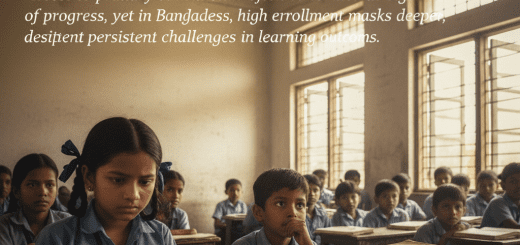
In Bangladesh, the classroom has long been seen as the foundation of national progress. But in many ways, it is also a front line of defense a quiet, often overlooked shield against one of the country’s darkest realities: human trafficking.
Recent policy research, reveals that gender-responsive schooling can reduce the risk of trafficking for girls by nearly 28 percent in high-vulnerability zones. This is not a symbolic claim. It’s grounded in measurable outcomes observed across border and coastal districts, where traffickers exploit poverty, displacement, and the promise of opportunity.
The Crisis We Don’t Confront Enough
Human trafficking in Bangladesh is not confined to shadowy criminal networks. It’s woven into poverty, migration, and weak institutions. The Global Slavery Index (2023) estimates that 1.2 million people in Bangladesh live under conditions of modern slavery about seven for every thousand citizens. Among them, thousands of girls are trafficked each year, often lured into forced labor or sexual exploitation.
In the camps of Cox’s Bazar, where displacement has stripped Rohingya families of both stability and legal protection, traffickers operate with terrifying precision. They exploit trust, language, and fear. Education, when it exists, becomes more than learning it becomes resistance.
How Education Protects
Bangladesh has made enormous progress in bringing girls to school. The World Bank (2022) reports that 91.3 percent of girls now complete lower secondary education, compared to 74.8 percent of boys. But attendance alone is not the story. What matters most is what happens inside those classrooms.
When schools integrate Gender-Responsive Education (GRE) a framework combining safe spaces, practical life skills, and gender sensitivity they don’t just educate; they empower. In UNICEF’s “Let Us Learn” programme, girls who received life skills training were 25 percent more likely to report unsafe situations and 30 percent more likely to reject coercive offers of marriage or work. That’s not theory it’s survival made measurable.
This protective power stems from something simple: knowledge and confidence. A girl who learns that she has rights, who knows the signs of manipulation, and who believes that her voice matters becomes much harder to deceive or control.
The Hidden Threat of Curriculum Instability
And yet, these gains are fragile. The government’s planned reversion to the 2012 national curriculum in January 2025 risks removing the very lessons that have proven most protective those focused on wellbeing, consent, and personal safety.
These are not abstract topics. They are the difference between silence and survival for thousands of girls. Rolling back such content, even partially, would weaken one of the few proven barriers against trafficking.
Justice Without Teeth
No education system can protect its students if the justice system refuses to protect them afterward. The 2024 U.S. Trafficking in Persons Report shows that most convicted traffickers in Bangladesh receive fines instead of jail. Many cases are settled through civil arbitration at the Bureau of Manpower Employment and Training (BMET), as though human exploitation were a business dispute.
This practice often referred to as the “impunity gap” strips trafficking of its criminal status and its deterrent power. When girls are taught in school that they have the right to report abuse, but their abusers walk free, it shatters the moral contract between citizen and state.
Poverty, Desperation, and the Economics of Exploitation
The trafficker’s weapon is not just deception it is desperation. Families pushed to the edge by poverty, river erosion, or joblessness often make impossible choices. Education alone cannot counter that.
World Bank research shows that when education is paired with financial support stipends, conditional cash transfers, or small livelihood incentives girls are 40 percent less likely to migrate unsafely or marry early. The message is clear: the fight against trafficking is as economic as it is moral.
What Needs to Change
If Bangladesh truly wants to turn education into a national shield, three things must happen.
- Protect the protective curriculum. Life skills and rights-based lessons must be made legally mandatory. These modules are as critical as math or science and far more urgent.
- Reform the justice system. Traffickers must face mandatory jail time, not fines. The BMET’s role in arbitrating trafficking cases must end.
- Target high-risk areas. Combine education, safety, and financial support in the border, coastal, and climate-affected districts where traffickers recruit most aggressively.
Education cannot carry the entire burden of justice, but it can prepare children to demand it.
A Final Reflection
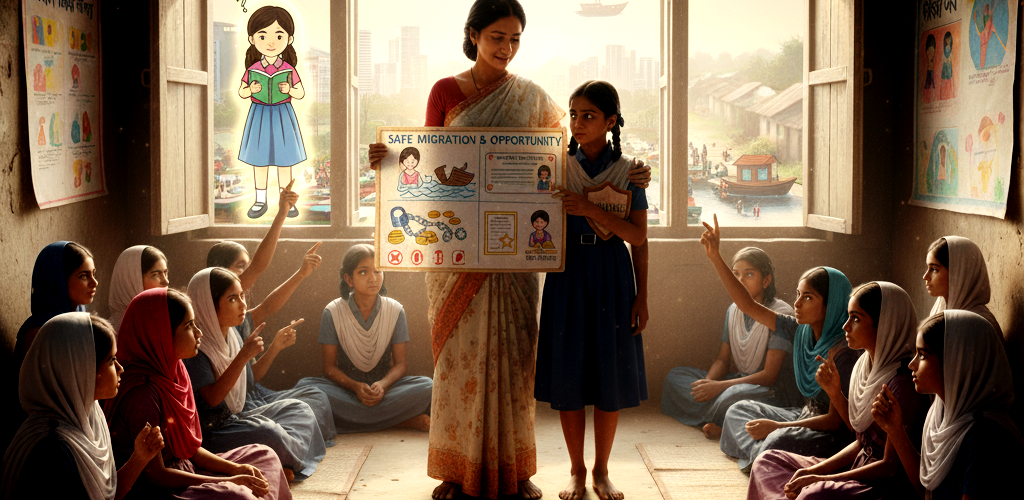
In one of my experiences, a 14-year-old girl from a border area told me quietly, “If I had not gone to school, I might have believed what the man said.” The man she referred to was a trafficker, posing as a recruiter. What stopped her was not luck, but a lesson she remembered about safe migration, about consent, about her right to say no. That single lesson was her shield.
Bangladesh has already proven that education can close gender gaps. It now has the chance to prove that education can also close the door to exploitation. The question is not whether we can afford to protect our girls it’s whether we can afford not to.
Data and Sources
- Global Slavery Index (2023): Country Data for Bangladesh Walk Free Foundation
- World Bank Gender Data Portal (2022): Lower Secondary Education Completion Rate World Bank
- UNICEF (2024): Let Us Learn Programme Evaluation UNICEF USA
- U.S. Trafficking in Persons Report (2024): Bangladesh Section U.S. Department of State
- UNFPA Bangladesh (2025): Review of National Curriculum and Life Skills Education UNFPA Bangladesh
- BRAC Annual Report (2024): Gender-Responsive Education Initiatives BRAC
- Dhaka Ahsania Mission (2024): Community Engagement for Girls’ Safety.