Effective Ways to Help Primary Students Improve Their Writing Skills
Supporting young learners to develop strong writing skills remains one of the most meaningful responsibilities of primary teachers. Writing is not only a literacy outcome; it also shapes how children understand ideas, express feelings, and communicate with the world around them. When children learn to write with clarity and purpose, they build confidence that touches every part of their education. Yet writing never develops automatically. It grows through repeated practice, structured guidance, and a classroom environment where children feel safe to take risks, make errors, and learn from them.
The techniques shared in the writing skills guide can be applied in any primary school, regardless of resources. They focus on what teachers can do directly in the classroom, using practical routines and simple methods. The following ten steps present a coherent, evidence-based approach that teachers can use to strengthen their students’ writing capacity throughout the school year.
1. Use clear and simple language: The first foundation of effective writing instruction is the language teachers use every day. Children understand best when instructions are short, direct, and free of unnecessary complexity. When teachers model simple and clear language, students naturally replicate the same patterns in their writing. Avoiding long explanations and breaking down ideas into small, manageable parts make writing tasks easier for learners who may still be developing basic literacy.
A practical routine is to end each lesson with a short writing prompt. After teaching a topic, ask students to write two or three lines that explain what they learned in their own words. This daily habit helps children transform spoken understanding into written expression. Over time, this improves sentence structure, vocabulary use, and overall confidence in writing.
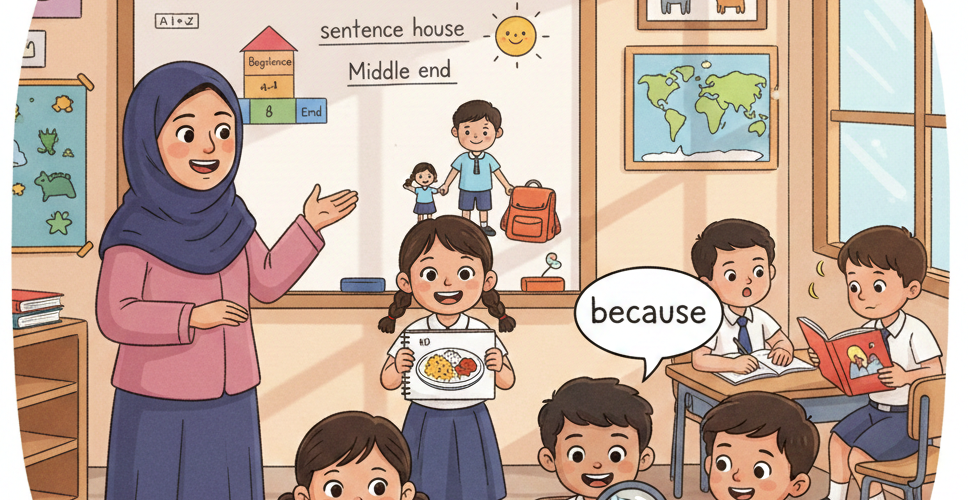
2. Teach a basic structure for every writing task: Young learners benefit greatly from predictable patterns. Teaching a simple and consistent writing structure gives them a clear path to follow. A basic approach includes one sentence to start the idea, two to three sentences to explain or describe it, and one sentence to conclude. This format can be applied to picture descriptions, short paragraphs, reflective writing, and even storytelling at the primary level.
To make this structure more meaningful, teachers can use guided questions. When children write about a picture, teachers can ask: What do you see? What is happening? How does it make you feel? These questions not only support the structure but also help young learners think critically about what they observe. With regular use, this structure becomes familiar, and students begin to organize their writing more independently.
3. Focus on familiar and relevant topics: Writing becomes much easier for children when the content is connected to their daily lives. When topics are meaningful and close to their experiences, children engage more naturally and write with greater clarity. Instead of starting with abstract ideas, teachers can choose topics based on home life, school events, festivals, routines, or simple personal experiences.
Short writing prompts such as “My morning routine,” “A day I felt happy,” or “My favourite food” allow children to express themselves without struggling to understand the topic. Familiar contexts reduce anxiety and help students develop a sense of ownership over their writing. This strategy is particularly effective for students who may be shy or unsure of their writing skills.
4. Build vocabulary gradually with consistent exposure: A strong vocabulary is essential for effective writing. Without words, children cannot express ideas clearly, even if they understand them. Teachers can help students build vocabulary through small, regular steps. Introducing three to five new words each day, along with simple definitions and sentence examples, steadily expands the range of words available to students during writing tasks.
To reinforce new vocabulary, teachers can encourage students to use the words in sentences, short stories, or descriptive tasks. Repetition is key. When children see and use a word multiple times, it becomes part of their active vocabulary. Creating a word wall or maintaining a classroom vocabulary notebook can also help students remember and revisit new words throughout the school year.
5. Teach linking words to connect ideas smoothly: One of the most common challenges in primary writing is disconnected sentences. Students often write one idea after another without linking them, making their writing sound abrupt. Teaching simple linking words such as because, but, so, after that, and for example enables children to create smoother and more logical writing.
Teachers can introduce linking words gradually and demonstrate how they change meaning. Classroom activities may include showing two simple sentences and asking students to combine them using a linking word. This helps children make connections between ideas and improves coherence in their paragraphs. As they grow comfortable with basic connectors, teachers can add slightly more advanced linking words to further strengthen their writing.
6. Introduce a simple proofreading routine: Proofreading is often considered an advanced skill, but even young learners can begin to check their work with guidance. Teaching students to review what they write builds responsibility, attention to detail, and self-correction habits. A simple checklist is highly effective at this level. The checklist may ask whether the student used capital letters correctly, ended sentences with full stops, spelled common words correctly, and ensured the writing makes sense.
Before submitting their work, students should be encouraged to read what they wrote, either silently or quietly aloud. This process helps them identify missing words, incomplete ideas, or unclear sentences. Over time, proofreading becomes an essential part of their writing routine, leading to cleaner and more accurate written work.
7. Develop writing skills step by step: Writing is a developmental skill. Children cannot be expected to write long paragraphs or stories from the beginning. Teachers must build writing ability gradually through a structured progression. Start with single-sentence writing, then move to two or three linked sentences, followed by short paragraphs, and gradually introduce longer descriptive or narrative tasks.
This approach lowers pressure and allows children to grow confidently at their own pace. Teachers can also differentiate writing tasks based on students’ levels. For example, some students may write one sentence about a picture, while others write a short paragraph. This flexibility ensures that every child experiences success while still being challenged appropriately.
8. Use visuals to support thinking and writing: Visuals play an important role in writing instruction, especially for young learners who may not yet have the vocabulary to express their ideas fully. Pictures, story strips, illustrations, and simple drawings help children think visually, which then translates into writing more easily. Visual prompts stimulate imagination, reduce anxiety, and make writing tasks more engaging.
Teachers can use a range of visuals depending on the lesson. A single image can prompt a descriptive paragraph. A sequence of pictures can support storytelling. A simple drawing can inspire creative writing. These methods help even the most reluctant writers participate in writing activities with greater interest and confidence.
9. Providing clear and balanced feedback: Feedback is a crucial part of writing instruction. Students need to know what they are doing well and where they can improve. Effective feedback is specific, constructive, and encouraging. Instead of marking every error, teachers can focus on one or two key areas for improvement. This prevents students from feeling overwhelmed and gives them clear goals for their next attempts.
For example, teachers might praise a student’s clear idea and then suggest adding one more sentence for detail. Or they may acknowledge improved spelling and remind the student to check punctuation. Balanced feedback builds motivation and helps students understand that writing improves through effort and practice, not perfection.
10. Make writing an enjoyable and regular classroom activity: Writing should not feel like a punishment or a stressful task. It should be a routine part of the classroom that students look forward to. Teachers can create engaging writing opportunities through daily warm-up writing, weekly journals, short creative challenges, class story corners, and collaborative writing tasks. These activities make writing more enjoyable and help children build fluency.
Regular writing is more effective than occasional long assignments. When students write a little every day, they gradually develop confidence, speed, and clarity. Making writing a positive experience encourages children to see themselves as writers, not just students completing tasks.
Improving writing skills at the primary level requires patience, consistency, and a strong understanding of how children learn. These ten strategies give teachers practical ways to support their students in developing clear, confident, and expressive writing habits. By using simple language, building structure, introducing new vocabulary, teaching linking words, and creating an engaging environment, teachers can help every child grow as a writer.
Writing is a skill that shapes a child’s academic journey and builds the foundation for future communication. When supported effectively, even the youngest learners can express their ideas with clarity and purpose. With steady guidance, meaningful practice, and a supportive classroom environment, primary students can develop the writing skills they need to succeed in school and beyond.