Curiosity in Early Childhood: Opening New Doors to Learning in Bangladesh
The Spark of Childhood Curiosity
Step into any pre-primary classroom in Bangladesh and the first thing you notice is the sparkle in children’s eyes. They are full of questions. Why is the sky blue? Where does rain come from? Why do flowers fade? How does a mobile phone work? Inside these questions lies the true joy of learning. Yet, the reality of our education system often prevents children from fully experiencing that joy.
The Challenge of Rote Learning
Too often, this natural curiosity fades under the weight of textbooks, rote memorization, and strict discipline from teachers and parents. Learning in many schools still means memorizing what is written in books or repeating what the teacher says. Children rarely get a chance to ask questions. Childhood is exactly the time when children should be learning how to ask, why to ask, and how to make sense of the world independently.
The Importance of STEM Education
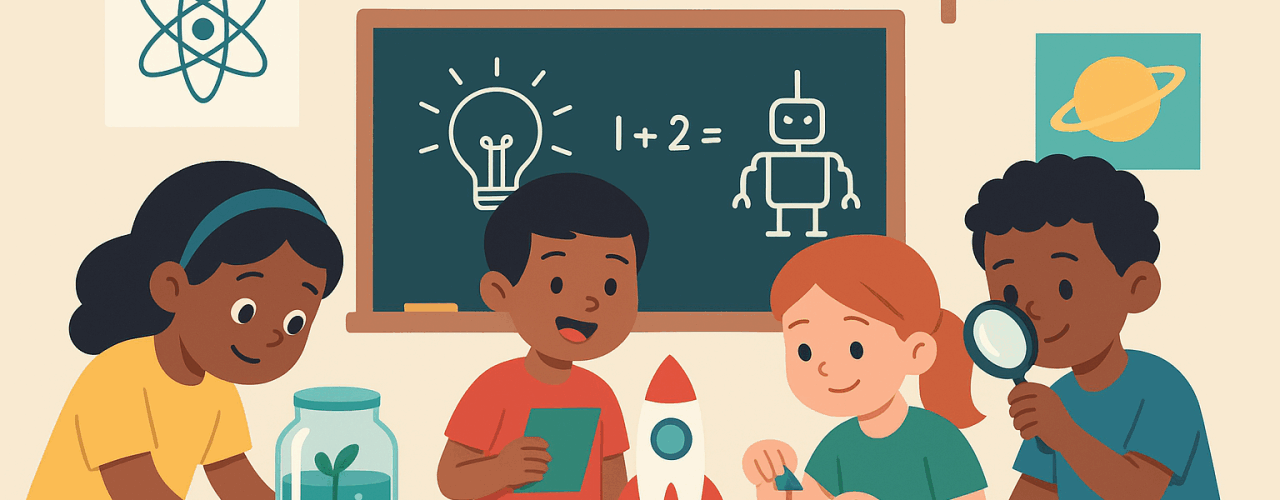
STEM education, which combines science, technology, engineering, and mathematics, offers a way to nurture curiosity. While science and math exist in the primary curriculum, they often remain confined to textbooks. Children need opportunities to learn by doing, touching, and experimenting. Learning through play, observation, and hands-on activities makes scientific thinking fun and natural.
For example, a bucket of water and a few paper boats can teach children concepts like weight, density, and buoyancy. Planting a seedling can help them understand life cycles and natural change. Simple experiments like these introduce children to problem-solving, reasoning, and observation from an early age.
Early Learning Shapes the Future
In the 21st century, good grades alone are not enough. The world requires people who can think critically, solve problems, and create new ideas. STEM education lays the foundation for these essential skills. It can start from the earliest years of schooling. It does not require expensive equipment, only a curious teacher and a willingness to explore. When a teacher says, “Let us see what happens,” children experience the joy of learning firsthand.
National Policies and Quality Learning
The National Education Policy 2010 recognizes pre-primary education as the foundation for lifelong learning. Despite this, many schools still rely heavily on rote memorization. The Primary Education Development Programme, PEDP4, focuses on quality learning. Incorporating STEM education into this framework would make children more eager and motivated to learn.
Evidence from Practice
UNICEF’s 2023 report highlights that play-based learning at an early age improves confidence, collaboration, and logical thinking. Children who learn through play grow up to be better problem-solvers and creative thinkers. Bangladesh already has examples of successful initiatives.
BRAC’s Play Lab model uses simple local materials to teach children concepts like size, balance, and measurement. In pre-primary schools in Rangpur and Khulna, Save the Children’s STEM programs allow children to explore through play, ask questions, and learn from mistakes. At JAAGO Foundation schools, children are introduced to basic science and technology ideas at an early stage, boosting their curiosity and confidence.
Overcoming Barriers
Challenges remain. Many teachers still lack training in hands-on STEM methods. A single teacher often manages thirty to forty children in one class. Parents frequently prioritize reading and writing over play-based learning. Despite these obstacles, play remains the most effective way to engage children. When children experiment, build, or even break things during play, they learn to think critically and understand the world. This is not only the beginning of science learning but also the start of lifelong curiosity.
Supporting Teachers and Schools
Teachers need training, support, and the freedom to transform classrooms into spaces of joyful discovery. The curriculum should include STEM-based activities and encourage play-based learning. Every school can create small science corners using local materials such as soil, water, seeds, and stones. Parents should also understand that play is not a luxury but a modern, effective way to learn.
A Vision for Bangladesh
Bangladesh has made remarkable progress in access to primary education, with almost all children attending school. The next challenge is quality education. Children need learning experiences that spark curiosity, build reasoning skills, and nurture creativity.
STEM education provides the path. It teaches curiosity, cooperation, and confidence. It shows children that mistakes are part of learning. If nurtured properly from an early age, children will grow into innovators, scientists, engineers, and problem-solvers. STEM education must start now to prepare them for the knowledge-based world of the 21st century.
When schools embrace this approach, children will not only succeed in exams but also help shape a smarter, more imaginative Bangladesh. Learning should begin through play. Children’s laughter and questions can light the way to a brighter future and a new kind of education.
References National Education Policy 2010, Ministry of Education, Bangladesh Primary Education Development Programme PEDP4, Directorate of Primary and Mass Education UNICEF 2023, Early Learning and the Future Skills Gap BRAC Institute of Educational Development 2022, Play Labs and Early STEM Learning in Rural Bangladesh