Affordable STEM Materials in Bangladeshi Primary Education: Bridging Access, Quality and Equity
Abstract
STEM education has become central to improving learning quality and preparing children for a fast-changing world. In Bangladesh, primary schools face severe constraints in introducing effective STEM learning due to limited resources, teacher capacity, and lack of appropriate materials. However, evidence shows that cost-friendly, locally sourced materials can significantly enhance engagement, comprehension, and problem-solving skills among students. This paper analyses the current state of STEM implementation in Bangladeshi classrooms, explores affordable material options, and provides practical and policy-level recommendations for integrating low-cost STEM tools into mainstream education. Drawing on data from the Directorate of Primary Education (DPE), CAMPE, UNICEF, and other studies, it argues that the success of STEM in Bangladesh depends not on technology investment but on empowering teachers and communities to innovate within local means.
Introduction
Primary education in Bangladesh stands at a critical juncture. On one hand, access has reached impressive levels: enrolment rates at the primary level are reported at approximately 97 percent according to BANBEIS data (BANBEIS, 2023). On the other hand, learning quality and equity remain serious concerns. Many children leave primary grades without firm foundations in literacy, numeracy and scientific reasoning. This gap is not simply due to attendance but to the nature of instruction, resources and pedagogical approaches used in classrooms.
In this context, STEM education (Science, Technology, Engineering and Mathematics) is increasingly seen as a strategic lever not just for technical skills, but for building critical thinking, problem solving and future‑ready learners. However, traditional visions of STEM often assume high‐cost laboratories, digital devices and imported kits. For the many primary schools in Bangladesh especially rural, marginalised or resource‑poor settings such visions are unrealistic. The pressing question becomes: How can STEM be made meaningful, feasible and equitable for all learners in Bangladesh?
This paper argues that low‑cost, locally sourced, easy‑to‑use STEM materials offer a practical, scalable solution. When combined with supportive pedagogy, teacher training and systemic policy alignment, these materials can shift classrooms from passive learning to active inquiry, from memorisation to meaning‑making. The analysis proceeds in four parts: (1) current constraints on STEM in the Bangladeshi primary context; (2) what low‑cost STEM materials look like and how they facilitate learning; (3) barriers and enabling conditions; and (4) policy recommendations for institutionalising this approach at scale.
Constraints on STEM Implementation in Bangladesh
Recent studies suggest a number of interrelated constraints to effective STEM education in Bangladesh. For example, Asghar et al. (2025) in a study “Bridging the gap: integrating STEM into educational practices in Bangladesh” found that insufficient laboratory facilities, inadequate instructional materials and a lack of teacher preparedness are major obstacles. Specifically, in their survey, a majority (61 percent) of students indicated that practical classes lacked adequate instruction or materials, leading to weak learning experiences (Asghar et al., 2025).
Another recent inquiry by Farhana et al. (2023) titled “Integrating STEM Approach in Primary Education of Bangladesh: Perception and Challenges of the Teachers” found that while most primary teachers believe STEM education is valuable, they face significant pedagogical and structural challenges: lack of STEM‐specific training, large class sizes, limited physical resources, and rigid curricula that emphasise rote learning rather than investigation (Farhana et al., 2023).
Curriculum documents and textbooks also show weak alignment with an inquiry‑based STEM approach. A 2024 study by Sultana et al., “Developing a framework for integrating STEM approach at primary education of Bangladesh,” found that existing Grade 3–5 mathematics and science textbooks offer only limited opportunities for integrated STEM activities and that curriculum redesign is needed (Sultana et al., 2024).
These constraints manifest in classrooms as teacher‑led lectures, minimal hands‑on work, limited peer interaction, and few locally adapted materials. The result: students often memorise facts but fail to apply them, transfer learning to new contexts or engage in problem‑solving. The national diagnostics show low proficiency in foundational concepts and this gap disproportionately affects children in remote, indigenous, or low‐income settings.
What Low‑Cost STEM Materials Look Like and Their Pedagogical Value
To shift this dynamic, one promising path is the use of low‐cost, locally sourced STEM materials. These are physical materials that are inexpensive, readily available (often via local markets or recycled items), easy to use by teachers and students, and aligned to curriculum aims. The pedagogical value of such materials lies in several areas:
- Concrete representation of abstract concepts – For many students, especially in early grades, abstract concepts in science and mathematics (e.g., force, measurement, growth, circuits) remain intangible. Manipulatives and hands‑on models help make these ideas concrete. For example, a plastic bottle filled partially with water, inverted, and made to form a siphon, can help children visualise fluid pressure and flow rather than merely reading about it.
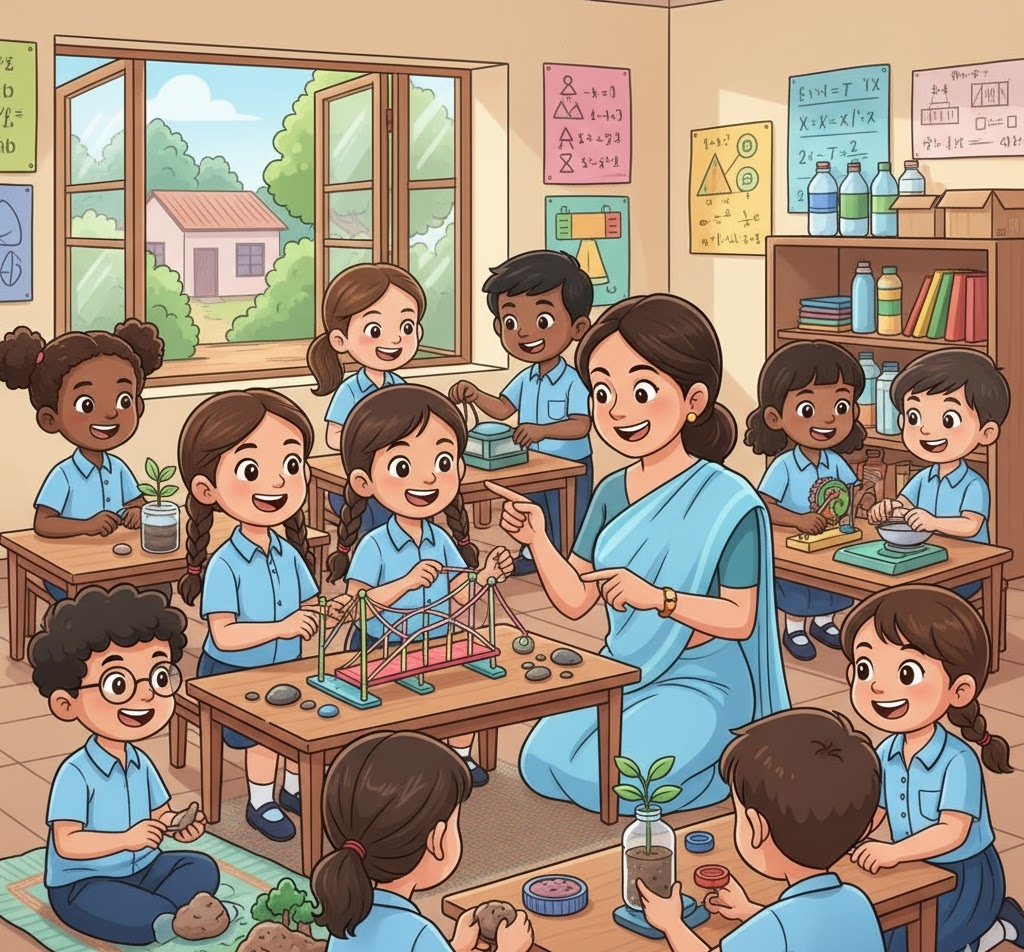
- Inquiry and experiential learning – Instead of passive listening, students engage in exploration, hypothesis, testing and reflection. This aligns with Vygotsky’s notion of the Zone of Proximal Development (i.e., learners construct knowledge through guided interaction) and Freire’s concept of dialogue‐based education (Freire, 1970; Vygotsky, 1978). Hands‐on materials support student‐centred inquiry: children experiment with straws to build bridges, use bottle caps to design wheels, or use soil and seeds in germination trays to observe growth.
- Local relevance and identity validation – When students work with materials drawn from their own context (for example, local seeds, recycled plastic, local craft sticks), the learning becomes culturally and socially anchored rather than alien. This helps inclusion: children from various socio‐linguistic backgrounds, indigenous communities or economically disadvantaged homes see the classroom as relevant to their world.
- Peer interaction and language support – Low‐cost materials often allow small‐group work. In a multilingual classroom or for children who are second‐language learners in Bangla, peer explanation, collaborative building of models, and active discussion support comprehension. Studies in Bangladesh show that children with limited Bangla proficiency benefit when instruction is contextualised and interactive (Farhana et al., 2023).
- Teacher adaptability and formative assessment – When materials are inexpensive and locally manageable, teachers can experiment, tweak, reuse, and encourage students to iterate. This enhances teacher agency, supports differentiated instruction, and allows formative assessment through observation of students’ construction, explanation and reflection rather than solely written tests.
Sample Materials and Classroom Activities
Here are practical examples of low‐cost materials and corresponding classroom activities:
- Plastic bottles (250‑1000 ml): Use for water flow experiments, siphons, buoyancy tests, seed germination.
- Bottle caps, skewers, sticks and rubber bands: Construct pulleys, simple gear‐wheels, levers for mathematics of force.
- Straws and string: Build bridge models, test load‐bearing capacity, explore measurement.
- Cardboard, corrugated sheets, small stones: Model ramp angles, friction, measurement of incline and distance.
- Clay or homemade dough (flour + salt + water): Visualise plant root systems, build soil layers, simulate earth layers.
- Seeds and soil in trays: Conduct experiments on germination under varied conditions (light, water, soil type).
- Small mirrors and magnifying glasses: Explore optics, reflection, simple magnification.
- Measuring cups, spoons, kitchen scales: Hands‑on numeracy, units of measurement, conversion (millilitres to litres, grams to kilograms).
- Cheap LEDs, small motors, batteries (for upper primary): Circuits, energy sources, experimentation.
A locally‐assembled class set of the above items can often be created for a relatively modest amount (e.g., under BDT 1,000) using recycled or budget items. In contrast, imported “science kit” sets cost tens of thousands of taka. Research from Pakistan showed that use of low‐cost materials for primary science resulted in a statistically significant improvement in student post‑test scores (Kanwal et al., 2022) and suggests promising transferability.
Barriers to Effective Implementation
Despite the strong rationale, several barriers hinder widespread adoption of low‐cost STEM materials in Bangladeshi primary classrooms:
- Teacher preparation and confidence
Many primary teachers report limited confidence in conducting experiments, building aids, or adjusting tasks for student variation. Farhana et al. (2023) found that although most teachers recognise the value of STEM, they lack training and support in how to implement it. - Time, class size and scheduling pressures
Large class sizes (often 40–60 students) and tightly packed schedules constrain opportunities for station teaching or group work. The traditional timetable prioritises completion of chapters rather than exploration. - Procurement, storage and maintenance
Low‐cost materials may be locally sourced, but schools often lack procurement flexibility, budget lines, or storage facilities. Rural schools may lack secure storage, causing materials to degrade or disappear. - Curriculum, assessment and accountability structure
If textbooks, assessments and official examinations continue to emphasise rote learning and recall, teachers may see hands‐on materials as “extra” rather than central. The curriculum alignment (Sultana et al., 2024) is still weak in this regard. - Mindset and educational culture
The perception of STEM as “advanced” or “luxury” rather than integral to early education persists. Without visible leadership and policy support, teachers may revert to conventional methods.
Enabling Conditions and Strategies for Implementation
To overcome these barriers, effective implementation of low‑cost STEM materials requires enabling conditions, including institutional, community and teacher‐level supports. Some promising strategies:
- Station teaching or rotational groups: Dividing a class into small groups and rotating through stations with simple materials allows engagement even in large classes.
- Community‑sourced local materials: Parent groups, local artisans, and small enterprises can donate or produce low‑cost STEM kits. This also builds community ownership and sustainability.
- Teacher resource corners and peer mentoring: District clusters or PTIs (Primary Teacher Institutes) can maintain demonstration kits and host peer observation for STEM teaching.
- Job‑aids and pictorial guides: Short, picture‐rich guidance is more effective for busy teachers than long manuals.
- Maintenance and reuse protocols: Schools should build simple inventory logs, designate student helpers or parent volunteers to maintain and repair materials.
- Integration into school improvement plans: Schools should include STEM material budget lines in School Level Improvement Plans (SLIP) under PEDP4, and link material use to SMC oversight.
- Professional development: Short, focused workshops on hands‑on STEM, followed by classroom follow‑up and reflection, build teacher competence and confidence.
Policy Recommendations
Institutionalising low‐cost STEM materials in Bangladesh’s primary sector requires policy actions at multiple levels. The following recommendations are directed at policymakers, donor agencies, teacher training institutes and school leaders:
- Embed low‑cost STEM material usage within the National Curriculum and Assessment Framework
The NCTB and DPE should revise the primary curriculum to explicitly include hands‑on activities using low‑cost materials and align assessments with inquiry‑based learning outcomes. The study by Sultana et al. (2024) provides a useful framework for this alignment. - Revise teacher training (pre‑service and in‐service) to include practical STEM materials modules
The DPEd curriculum should include mandatory practical sessions on locally produced STEM materials; PTIs should host demonstration labs and share low‐cost kit designs. Teacher evaluation should include a dimension of material‑based instruction. - Create a National Low‑Cost STEM Resource Bank under DPE
This resource bank would curate open‑access Bangla guides, unit‑activity templates, local material sourcing lists and case studies. Teachers across Bangladesh can access and share resources, reducing redundancy and cost. Donor and NGO efforts can feed into this repository. - Allocate micro‑grants and provide procurement flexibility for schools
Under PEDP4, SMC grants and school improvement funds should include a dedicated line for STEM materials (e.g., BDT 3,000–5,000 annually for each school). Schools should be permitted to purchase locally produced kits or recycled‑material sets rather than only standard commercial kits. - Promote public‑private/local enterprise partnerships for kit production
The Government of Bangladesh, in partnership with NGOs and social enterprises (such as Platform STEM Bangladesh or RobotechBD), should support the development of low‑cost STEM kits tailored to the local curriculum and climate. Local production reduces cost, builds capacity and ensures maintenance feasibility. - Monitor and evaluate learning outcomes associated with material use
The Annual School Census (ASC), National Student Assessment (NSA) and other surveys should include indicators on hands‑on STEM exposure, material availability and teacher confidence. Longitudinal studies should link material use with student outcomes, especially for disadvantaged groups. - Foster community involvement and monitor sustainability
Communities (via SMCs and parents) should be engaged in sourcing, maintaining and funding low‑cost materials. Local artisans and parent groups can host recycling drives, produce parts, and build ownership. This aligns with Bronfenbrenner’s ecological systems theory, emphasising the role of family and community in the educational environment. - Ensure equity‑focused targeting
Schools in remote, indigenous, and low‑income areas should receive priority in material grants and training support. Because these schools often have the greatest resource gaps, targeted interventions strengthen equity and support SDG 4.5 (elimination of disparities in education).
Analytical Implications and Discussion
The implications of shifting to low‐cost STEM materials in Bangladesh are multi‑fold. First, it signals a move from technology‐centric “lab in a box” models to resource‐sensitive, context‐rooted praxis. This aligns with global research that emphasises pedagogy over hardware. For instance, the literature review by Nayem & Hossain (2023) emphasised the importance of material availability and teacher strategy rather than simply infrastructure in STEM adoption.
Second, focusing on low‐cost materials emphasises equity. Rather than creating “rich‐school STEM labs”, it democratizes access to inquiry‑based learning. When students from marginalized or remote areas gain the same ability to tinker, experiment and observe, it reduces the “STEM divide”. This supports Bangladesh’s goals under SDG 4 (quality, inclusive education) and the Education Sector Plan (ESP).
Third, this approach fosters teacher agency and innovation. When teachers are empowered to create or adapt materials from their environment, they become reflective practitioners rather than mere deliverers of the textbook. This professionalisation of teachers is in line with PEDP4’s emphasis on teacher development.
However, the success of this model depends on systems: sustained support, monitoring, curriculum alignment, budget flexibility, and community engagement. Without systemic alignment, low‐cost materials could remain a pilot novelty rather than mainstream practice. The literature cautions that materials alone are insufficient if pedagogy, context and institutional support are weak (Asghar et al., 2025).
There is also an economic dimension. While low‐cost materials are inexpensive at the school level, systemic scaling (for ~50,000 primary schools) requires investment. Yet, a cost‑benefit argument reveals favourable returns. If each school allocated even a modest annual budget for low‐cost STEM materials (say BDT 3,000), the cumulative national investment (~BDT 150 million) is modest compared to other education expenditures. In contrast, imported kits for each classroom cost tens of thousands of taka, and typically serve only limited grades. Therefore, low‐cost approaches present efficient use of funds.
Moreover, by using locally recycled or easily sourced items, this model promotes environmental consciousness, resourcefulness and sustainability—an added value in teaching children for the 21st century.
Limitations and Research Gaps
While the case for low‑cost STEM materials is strong, several research gaps remain. Many of the existing studies (e.g., Farhana et al., 2023; Sultana et al., 2024) focus on teacher perceptions, frameworks or small pilots rather than large‐scale impact evaluations. Quantitative data linking material use with student long‐term outcomes (e.g., secondary STEM enrolment, problem‐solving skills, workplace readiness) is scarce. Similarly, cost‑effectiveness studies in the specific Bangladeshi context remain limited.
There is also the challenge of replication: materials and activities that succeed in one region may need adaptation elsewhere due to linguistic, cultural or material differences. More research is needed on how to scale, contextualise and sustain these practices over time.
Conclusion
In Bangladesh’s efforts to improve primary education quality, low‑cost, locally usable STEM materials represent a strategic, equitable and feasible pathway. By moving away from expensive laboratory models and embracing everyday materials, classrooms can become places of inquiry, collaboration and relevance. But success requires more than items on a shelf: it demands pedagogical shifts, teacher preparation, curriculum alignment and policy‑systemic support.
If Bangladesh institutionalises this approach – via curriculum, teacher training, resource banks, micro‑grants and community engagement – it could transform primary classrooms from passive zones of memorisation into active spaces of experimentation, meaning‑making and readiness for a rapidly changing world. As the Scandinavian educator Knud Illeris once noted: “Learning that lasts is learning that is used.” Low‑cost STEM materials help children use, not just see, science and mathematics.
References
Asghar, A.S.M.S., Chowdhury, S.A., & Nishat, M.T.A. (2025). Bridging the gap: integrating STEM into educational practices in Bangladesh. SN Social Sciences, 5, 30. https://doi.org/10.1007/s43545-025-01060-6
BANBEIS. (2023). Bangladesh Education Statistics 2023. Ministry of Education, Government of Bangladesh.
Farhana, Z., Sultana, T., Al‑Amin, M., & Haque, S. (2023). Integrating STEM Approach in Primary Education of Bangladesh: Perception and Challenges of the Teachers. Global Journal of Human‑Social Science, 23(G8), 39–49. https://doi.org/10.34257/GJHSSGVOL23IS8PG39
Kanwal, W., Shahid, S., & Jabeen, F. (2022). Effectiveness of low cost material to teach science at primary level. Journal of Management Practices, Humanities and Social Sciences, 6(2), 102‑110. https://doi.org/10.33152/jmphss-6.2.12
Sultana, T., Farhana, Z., Hoque, S. et al. (2024). Developing a framework for integrating STEM approach at primary education of Bangladesh. Discover Education, 3, 112. https://doi.org/10.1007/s44217-024-00188-6
Freire, P. (1970). Pedagogy of the Oppressed. Continuum.
Vygotsky, L. (1978). Mind in Society: The Development of Higher Psychological Processes. Harvard University Press.