Importance and Impacts of Storytelling in Primary Science and Mathematics Teaching
In the realm of primary education, teachers constantly search for approaches that make learning both meaningful and engaging. Amidst digital tools, interactive boards, and innovative pedagogy, one age-old method continues to demonstrate remarkable effectiveness: storytelling. Beyond mere entertainment, storytelling has emerged as a powerful tool to teach science and mathematics to young learners, bridging abstract concepts with tangible understanding, fostering curiosity, and shaping the way children think and learn.
Why Storytelling Matters in Early Education
Primary education is a critical stage in a child’s intellectual and emotional development. At this age, children are naturally curious but often find abstract concepts in science and mathematics challenging to grasp. Numbers, formulas, and scientific phenomena can appear disconnected from their daily experiences. Storytelling addresses this challenge by embedding learning within meaningful narratives that children can relate to.
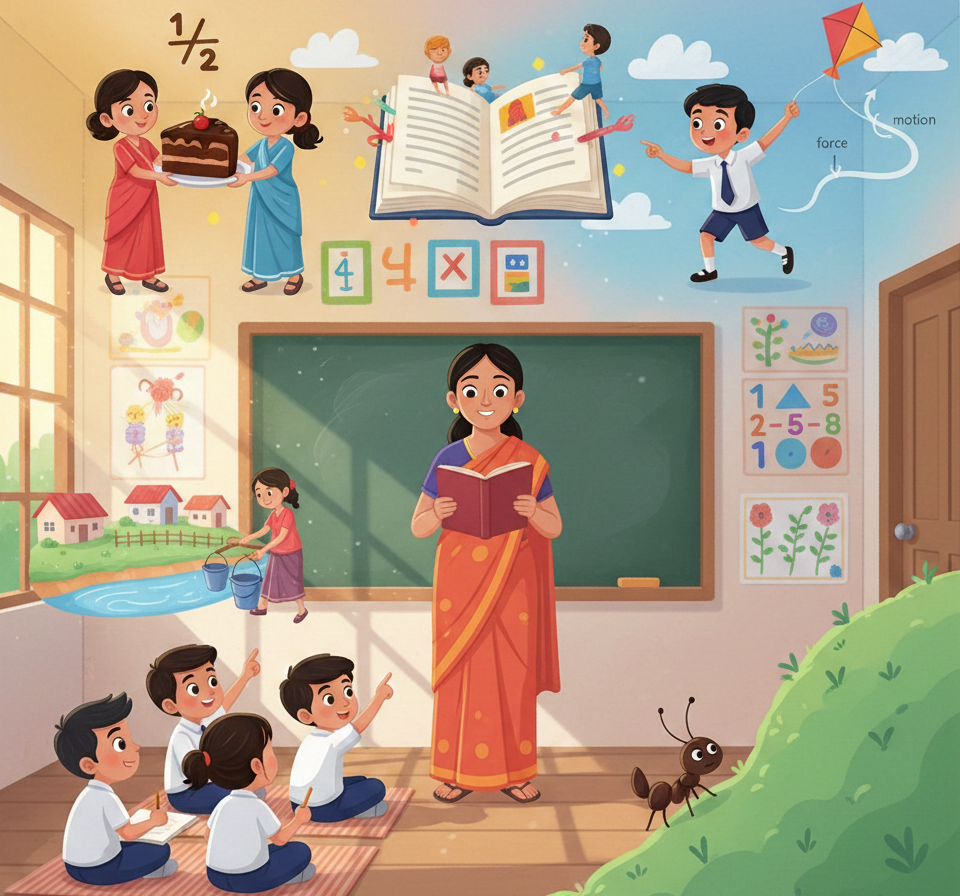
For example, consider teaching fractions. Many children struggle to understand that 1/2 is just one part of a whole. A teacher might tell a story about two friends sharing a chocolate cake or a village distributing water evenly among households. Suddenly, the concept of fractions is no longer abstract; it becomes a relatable, memorable scenario. Similarly, teaching principles of force and motion can be made vivid by narrating the adventures of a child flying a kite or an ant climbing a steep slope. Stories give life to abstract ideas, making them easier to understand and recall.
Cognitive research supports this approach. Studies show that stories enhance memory and retention by linking information to emotions and real-world contexts. When children visualize characters, problems, and situations, learning becomes experiential rather than rote. Storytelling turns passive listening into active thinking, encouraging students to anticipate, question, and explore.
Enhancing Critical Thinking and Problem-Solving
Storytelling in mathematics and science is not merely about engagement—it nurtures higher-order thinking skills. Presenting problems within a narrative encourages children to analyze, evaluate, and propose solutions. For instance, a story about a community facing water scarcity can serve as a practical exercise in measuring volumes, calculating usage, and predicting future needs. Children are challenged to apply mathematical operations while thinking critically about real-world implications.
Similarly, science concepts become more meaningful when embedded in a story. A tale about a mysterious plant that grows differently in sunlight and shade can introduce children to experimental observation, hypothesis formation, and data analysis. Storytelling transforms the scientific method from an abstract procedure into an interactive, imaginative exploration. This method aligns with inquiry-based learning principles, promoting curiosity and analytical thinking from an early age.
Emotional and Social Impacts of Storytelling
Beyond cognitive gains, storytelling fosters emotional and social development. Narratives often include characters facing dilemmas, conflicts, or challenges, allowing children to empathize and reflect. In mathematics and science, these stories can depict collaboration, decision-making, or ethical problem-solving. For example, a story about a group of students designing a small bridge to cross a stream encourages teamwork, negotiation, and planning, blending technical knowledge with social skills.
Moreover, storytelling can promote inclusivity in classrooms. By integrating stories from diverse cultures, backgrounds, and experiences, teachers ensure that all students see themselves reflected in learning. This representation strengthens engagement, motivation, and self-confidence. When children connect personally with content, learning becomes more meaningful and impactful.
Practical Applications in Science and Mathematics
Storytelling can be integrated into science and mathematics teaching in multiple practical ways:
- Problem-Based Stories: Present mathematical or scientific problems as part of a narrative. For example, calculating how much water a village needs in a drought scenario teaches both arithmetic and resource management.
- Character-Led Learning: Introduce recurring characters who face scientific challenges or mathematical puzzles. Children can follow their adventures across lessons, building continuity and engagement.
- Role Play and Simulation: Allow students to act out stories that involve scientific phenomena or mathematical situations. A classroom “mini-laboratory” story can simulate concepts like evaporation, plant growth, or measurement.
- Creative Story Creation: Encourage children to write or narrate their own stories involving numbers or scientific concepts. This fosters creativity, reinforces understanding, and develops communication skills.
- Multimedia Storytelling: Combine videos, animations, and interactive digital stories to explain concepts. While traditional stories remain powerful, multimedia can enhance visualization and engagement, particularly for complex ideas.
Global Practices and Evidence
Around the world, educators increasingly recognize storytelling as a tool for STEM education in early childhood. In Finland, primary classrooms incorporate story-based science modules, allowing students to explore natural phenomena through narratives. Singaporean schools use storytelling to teach problem-solving in mathematics, showing improvements in engagement and conceptual understanding.
Research corroborates these findings. A study published in the International Journal of STEM Education revealed that students exposed to story-based learning scored significantly higher in retention and application of concepts compared to traditional lecture-based instruction. Another study in the Journal of Educational Psychology highlighted that narrative-driven science lessons increased student curiosity, inquiry, and participation, particularly among children aged 6–10. These examples underscore storytelling’s universal applicability and adaptability across cultures and curricula.
Storytelling as a Tool for Teacher Development
Implementing storytelling effectively requires preparation and skill. Teachers must design stories that align with curriculum objectives while remaining flexible to students’ responses. Professional development programs can equip teachers with techniques to craft compelling narratives, integrate role play, and encourage student-led storytelling. Simple props, drawings, or interactive simulations can further enhance engagement.
Moreover, storytelling allows teachers to observe students’ thought processes in real time. By listening to how children interpret problems within a story, educators can identify misconceptions, gaps in understanding, and individual learning styles, tailoring instruction accordingly. This makes storytelling not only a teaching tool but also a diagnostic strategy for continuous improvement.
Challenges in Implementation
Despite its benefits, storytelling in primary science and mathematics faces challenges. Large class sizes, time constraints, and rigid curricula can limit opportunities for narrative-based teaching. Standardized testing pressures may also discourage creative approaches. However, research and practice show that even brief, carefully designed stories can significantly enhance comprehension and engagement. The focus should be on quality and relevance, rather than quantity or length.
Impact on Long-Term Learning and Curiosity
The effects of storytelling extend beyond the immediate classroom. By connecting abstract concepts to real-world situations, children develop deeper understanding, stronger problem-solving abilities, and lasting curiosity. This foundation is crucial for lifelong learning, as students who experience meaningful, engaging, and relatable lessons are more likely to pursue STEM subjects confidently in later stages of education.
Additionally, storytelling cultivates skills beyond academics. Communication, collaboration, creativity, and empathy all grow when children participate in narrative-driven learning. In a rapidly changing global environment, these skills are as important as factual knowledge. Storytelling, therefore, contributes to holistic development, preparing children not just to succeed academically, but to thrive socially and emotionally.
Conclusion
Storytelling is not merely a pedagogical option; it is an essential strategy for teaching science and mathematics at the primary level. It transforms abstract concepts into relatable experiences, enhances memory and understanding, fosters critical thinking and problem-solving, and nurtures social and emotional development. Global evidence and classroom practices consistently highlight its effectiveness, demonstrating that the power of narrative is universal.
In an era of rapid technological advancement, it is easy to overlook simple, human-centered methods of teaching. Yet, stories remain unmatched in their ability to connect ideas, evoke curiosity, and shape young minds. For primary learners, every lesson told as a story is not just information delivered—it is an invitation to explore, question, and imagine.
Investing in storytelling in primary education is an investment in curiosity, creativity, and lifelong learning. Teachers, policymakers, and educators worldwide must recognize its transformative potential, ensuring that classrooms remain spaces where learning is not just seen and heard, but experienced, felt, and remembered.