From Rote Learning to Meaningful Inquiry: Strengthening Learning Quality and Student Agency in Bangladesh Primary Education
Executive Summary
Over the past three decades, Bangladesh has made significant progress in expanding access to primary education. Net enrollment has reached near universal levels, gender parity has largely been achieved, and primary education infrastructure has expanded to almost every corner of the country. These achievements reflect sustained political commitment, effective policy direction, and strong collaboration between government, development partners, and communities.
However, as access has expanded, concerns regarding the quality and equity of learning have become increasingly visible. Evidence from National Student Assessments, classroom based studies, and post Covid learning recovery assessments consistently shows that a large proportion of primary students are not achieving expected levels of foundational literacy, numeracy, and problem solving. These learning gaps are not evenly distributed. Children from rural areas, urban slums, low income households, and marginalized communities continue to fall behind, despite attending school regularly.
The Covid 19 pandemic further exposed and intensified these challenges. Prolonged school closures disrupted learning routines, widened existing inequalities, and resulted in significant learning loss, particularly among younger children and first generation learners. While schools have reopened and recovery efforts are underway, the pandemic underscored a deeper structural issue. The prevailing model of teaching and learning in primary education is not sufficiently resilient, inclusive, or effective in ensuring meaningful learning for all children.
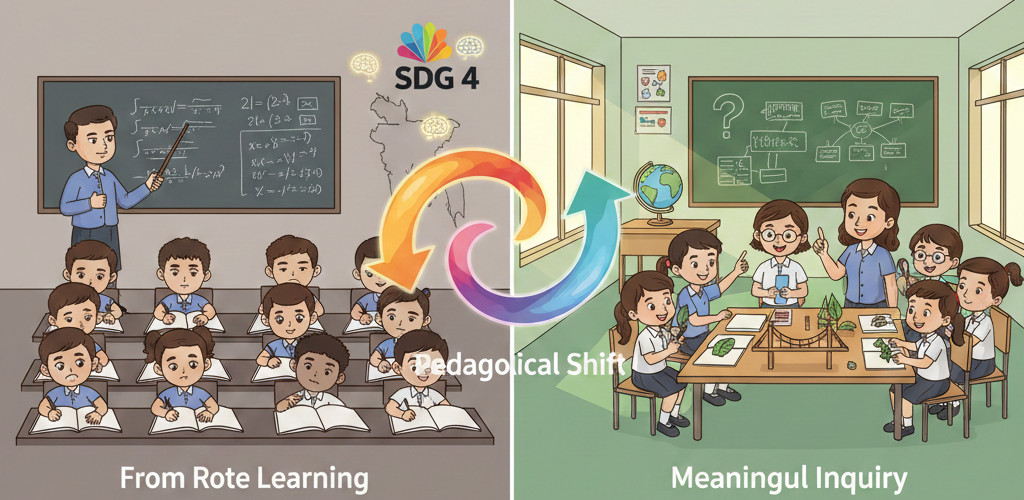
This policy brief argues that addressing learning quality challenges requires more than curriculum revisions or short term remedial programs. It calls for a deliberate pedagogical shift toward inquiry based, learner centered teaching that prioritizes conceptual understanding, student agency, and application of learning. Drawing on international research, constructivist learning theory, and Bangladesh’s own policy commitments under SDG 4 and PEDP 4, the brief outlines a practical and system aligned approach to integrating inquiry based learning within existing structures.
The proposed shift does not require radical restructuring of the education system or high cost investments. Instead, it emphasizes changes at the classroom level, strengthened teacher professional development, alignment of assessment practices, and use of existing institutional mechanisms under PEDP 4. By focusing on how teaching and learning occur, rather than only what is taught, Bangladesh can move beyond access toward meaningful and equitable learning outcomes for all primary school children.
1. Introduction
Bangladesh stands at a critical juncture in the evolution of its primary education system. The foundational challenge of expanding access has largely been addressed. The central question now concerns what children are learning in school and how that learning prepares them for future life, work, and citizenship.
Primary education serves as the bedrock of the entire education system. Skills developed during these early years shape children’s academic trajectories, social development, and capacity for lifelong learning. Weak foundations at the primary level are difficult and costly to correct later. Therefore, improving learning quality in primary education is not only an educational priority but a national development imperative.
Despite sustained investments through successive phases of PEDP, classroom practices in many primary schools remain largely unchanged. Teaching continues to be dominated by textbook driven instruction, whole class lecturing, and rote memorization. Assessment systems reinforce these practices by rewarding recall rather than understanding. Teachers, constrained by time, class size, and accountability pressures, often feel compelled to prioritize syllabus completion over meaningful engagement.
At the same time, policy frameworks increasingly emphasize competency based learning, inclusion, and relevance. This gap between policy intent and classroom reality represents one of the most significant challenges facing primary education reform in Bangladesh.
This policy brief seeks to bridge that gap by articulating a clear pedagogical direction grounded in inquiry based learning. It examines why inquiry based pedagogy is relevant to Bangladesh, how it aligns with existing policies, and what practical steps can be taken to implement it within PEDP 4.
2. The Learning Crisis in Bangladesh Primary Education
2.1 Evidence of Learning Gaps
Multiple sources of data point to persistent learning challenges in Bangladesh’s primary education system. National Student Assessment results have repeatedly shown that many students struggle with reading comprehension, basic numeracy, and problem solving by the end of primary school. Classroom based assessments conducted by development partners reveal similar patterns, with wide variation in learning levels within the same grade.
Learning loss following Covid 19 further exacerbated these challenges. Studies conducted after school reopening indicated that many students returned to classrooms having forgotten previously acquired skills. Younger children, who missed critical periods of early literacy and numeracy instruction, were particularly affected.
2.2 Unequal Impact Across Groups
Learning gaps are not evenly distributed. Children from poorer households often lack access to learning support at home. Rural schools face teacher shortages and limited resources. Urban slum schools struggle with overcrowding and high student mobility. Girls in some contexts face social constraints that limit participation and confidence.
Children with disabilities and learning difficulties are often the most excluded, as teaching methods rarely accommodate diverse learning needs. These disparities highlight the need for teaching approaches that are flexible, responsive, and inclusive.
2.3 Structural Causes
The persistence of learning gaps cannot be attributed solely to individual teachers or schools. Structural factors play a significant role. These include exam oriented accountability systems, rigid curricula, limited instructional time, and professional development models that focus more on compliance than pedagogy.
At the classroom level, the dominant model of instruction prioritizes transmission of information rather than construction of understanding. Students are expected to memorize content and reproduce it in examinations. This approach may produce short term gains in test scores, but it does not foster deep understanding or transferable skills.
3. Policy Context and Strategic Alignment
Bangladesh’s commitment to improving learning quality is clearly articulated in national and international policy frameworks. This policy brief aligns with and supports the following commitments.
3.1 Sustainable Development Goal 4
SDG 4 emphasizes inclusive and equitable quality education and lifelong learning opportunities for all. Target 4.1 focuses on effective learning outcomes, while Target 4.7 highlights education for sustainable development, global citizenship, and critical thinking. Achieving these targets requires pedagogies that go beyond memorization and promote understanding, reflection, and action.
3.2 Primary Education Development Program Phase 4
PEDP 4 identifies foundational learning, teacher development, inclusion, and system strengthening as key priorities. While substantial resources have been allocated to infrastructure, materials, and training, greater emphasis is needed on how teaching and learning take place in classrooms.
3.3 National Curriculum Framework and Education Policy
Recent curriculum reforms signal a shift toward competency based learning. However, without corresponding changes in pedagogy and assessment, these reforms risk remaining largely symbolic.
Inquiry based learning provides a practical mechanism to operationalize these policy commitments at the classroom level.
4. Understanding Inquiry Based Learning
Inquiry based learning is an approach that places learners at the center of the learning process. It begins with students’ prior knowledge and questions, encourages exploration and dialogue, and emphasizes reflection and application of learning.
Rather than viewing knowledge as a fixed body of facts to be transmitted, inquiry based learning treats knowledge as something that learners actively construct through interaction with ideas, materials, peers, and teachers.
This approach draws on well established learning theories. Piaget emphasized active knowledge construction. Vygotsky highlighted the social nature of learning and the importance of guided interaction. Freire argued for education that empowers learners through dialogue and critical reflection.
Inquiry based learning does not imply abandoning structure or standards. It requires careful planning, clear learning goals, and skilled facilitation by teachers.
5. Why Inquiry Based Learning Matters for Bangladesh
5.1 Addressing Learning Loss and Variation
Inquiry based approaches are particularly effective in classrooms with diverse learning levels. By engaging students actively and building on what they already know, inquiry allows teachers to respond to variation more effectively than one size fits all instruction.
5.2 Supporting First Generation Learners
Many Bangladeshi children are first generation learners who receive limited academic support at home. For these children, classroom pedagogy plays a decisive role. Inquiry based learning helps make abstract concepts meaningful and accessible.
5.3 Promoting Gender Equity and Inclusion
Inquiry based classrooms create opportunities for dialogue and collaboration, which can increase participation and confidence among girls and marginalized students. When teachers intentionally facilitate inclusive discussion, power dynamics within classrooms can shift.
5.4 Enhancing Relevance
Inquiry allows learning to be connected to local contexts such as climate change, health, livelihoods, and community life. This relevance increases motivation and helps students see the value of education beyond examinations.
6. Student Agency as a Foundation for Learning
Student agency refers to learners’ capacity to influence their learning through voice, choice, and ownership. Agency is not about loss of discipline. It is about meaningful participation.
In traditional classrooms, students often have little opportunity to express ideas or make decisions. Inquiry based learning creates space for students to ask questions, explain reasoning, and take responsibility for tasks.
Agency is particularly important for children who have historically been marginalized. It supports motivation, resilience, and a sense of belonging.
7. Implications for Teacher Professional Development
Teachers are central to the success of any pedagogical reform. Inquiry based learning requires teachers to adopt new roles as facilitators and guides.
Professional development must therefore move beyond one off training sessions. It should include practical strategies for questioning, group work, formative assessment, and reflection. School based mentoring, peer learning communities, and instructional coaching are essential.
Training institutions under MoPME and DPE need to align their programs with these goals.
8. Curriculum Implementation and Classroom Practice
While curriculum documents emphasize competencies, classroom implementation remains content heavy. Teachers need clear guidance on how to translate competencies into daily lessons.
Teacher guides should include examples of inquiry questions, classroom activities, and assessment strategies aligned with learning goals. Flexibility should be encouraged to allow teachers to adapt lessons to local contexts.
9. Assessment Reform to Support Learning
Assessment practices play a powerful role in shaping classroom behavior. When assessments reward memorization, inquiry based teaching is discouraged.
Formative assessment strategies such as observation, questioning, student explanations, and simple performance tasks can provide valuable information about learning. These approaches should be integrated within existing assessment systems rather than treated as add ons.
10. School and Community Partnerships
Learning does not occur in isolation from children’s social environments. Inquiry based projects that involve families and communities can strengthen relevance and accountability.
Existing community engagement mechanisms under PEDP 4 can support such initiatives, fostering shared responsibility for learning.
11. Implementation Strategy Under PEDP 4
Implementation should be gradual and context sensitive. Pilot programs in diverse settings can generate evidence and refine approaches. Existing institutional structures should be used to avoid duplication.
Monitoring should focus on classroom practice and student engagement, not just training completion.
12. Risks and Mitigation
Potential risks include teacher overload, superficial adoption, and misalignment with assessment systems. These risks can be mitigated through phased implementation, continuous support, and policy coherence.
13. Conclusion
Bangladesh has reached a stage where improving learning quality is the central challenge of primary education. Inquiry based learning offers a practical and evidence informed pathway to address learning loss, inequity, and relevance.
By investing in pedagogy, teacher support, and student agency, MoPME and PEDP 4 can ensure that primary education not only brings children into school, but equips them with the understanding, skills, and confidence needed for life.