Let Curiosity Be Their First Lesson: Why STEM Belongs in Early Childhood Classrooms
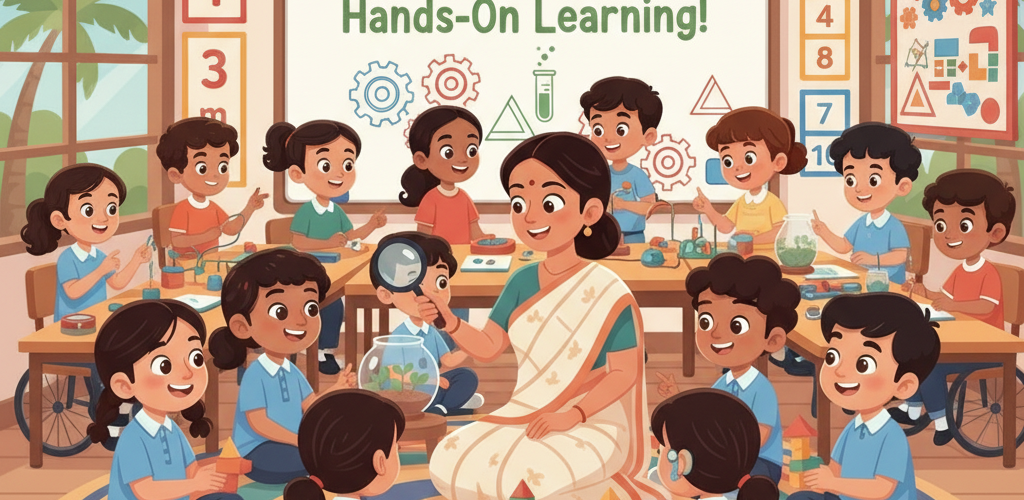
Walking into any pre-primary classroom in Bangladesh reveals a small world filled with laughter, energy, and countless curious eyes. The children wonder about everything around them. They ask why the sky is blue, where the rain comes from, why flowers dry up, or how a phone lets people talk from far away. Each question opens a new window to learning. Yet this natural curiosity fades too quickly under the weight of rote learning and the pressure to memorize facts instead of exploring ideas.
In most schools, learning still means reading from a textbook and repeating what the teacher says. There is little room to ask questions or make mistakes. But real learning begins with curiosity with the courage to ask “what” and “why.” That courage can be nurtured through STEM education, which stands for Science, Technology, Engineering, and Mathematics.
Learning Beyond Textbooks
Science and mathematics are already part of the primary curriculum in Bangladesh, but they often remain confined to the pages of books. Children memorize the word “gravity” without ever dropping a ball to see how it falls. They learn about geometric shapes from pictures, not from touching and building them. Yet children learn best when they can see, touch, explore, and play.
With simple, local materials, even the most basic concepts can come alive. A bucket of water and paper boats can teach floating and sinking. A small seed can teach about life, growth, and patience. These everyday experiences turn abstract ideas into joyful learning.
The world no longer rewards memorization alone. The future needs people who can think critically, solve problems, and create new things. That’s why STEM education should start early when children are most curious. It doesn’t require expensive labs or digital tools. It needs teachers who can say, “Let’s find out together.”
Policy and Practice
Bangladesh’s National Education Policy 2010 recognizes early childhood education as the foundation of lifelong learning. The ongoing Primary Education Development Programme (PEDP4) focuses on improving quality and equity. But true change will come only when classrooms embrace play, discovery, and STEM thinking as part of everyday teaching.
UNICEF’s 2023 report shows that play-based learning builds children’s confidence, cooperation, and reasoning skills. Bangladesh already has some encouraging examples. BRAC’s “Play Lab” model uses local materials to teach measurement, balance, and shapes through play. Save the Children has introduced playful science activities in several schools. Jago Foundation’s classrooms allow children to experiment with basic technology and science, building curiosity and confidence.
These examples show that quality education does not depend on fancy buildings or expensive tools. What matters most is imagination and genuine care.
The Human Side of Learning
Brazilian educator Paulo Freire once said that education becomes meaningful only when it connects with life. Yet many classrooms in Bangladesh remain trapped within textbooks and exams. STEM education can open that closed window. It teaches children to think for themselves, to work with others, and to see mistakes as part of learning.
There are, of course, challenges. Many teachers have not received training in play-based or hands-on teaching. Overcrowded classrooms make it hard to give attention to every child. Some parents still believe that playing means wasting time. But play is not a waste, it is the most natural form of learning.
When a child builds something with blocks or mixes colors to see what happens, they are not just playing. They are exploring, thinking, and asking questions. And every question is the first step toward understanding.
Building Strong Foundations
To bring real change, the transformation must begin with teachers. They need training, support, and time to teach in new ways. Every school can create small science corners using local materials like water, soil, seeds, stones, and blocks. Parents must also understand that learning through play is not a distraction, it is a powerful way to prepare children for life.
Bangladesh has achieved near-universal primary enrollment, a remarkable success. Now the next goal is to ensure that every child not only attends school but also learns with curiosity and confidence. Education should build thinking minds, not just test-taking habits.
The Future Begins in the Classroom
Children today are growing up in a world that changes every moment. New technologies, new ideas, and new challenges are reshaping daily life. They will face problems we cannot yet imagine. Rote learning will not prepare them for that world, but curiosity will.
If curiosity is nurtured early through play and hands-on exploration, we can raise a generation of thinkers, creators, and problem-solvers. STEM education is not only about science or numbers. It is about teaching children to wonder, explore, and imagine.
Behind every “what” and “why” lies a spark that can light the path to discovery. If children are allowed to ask, to explore, and to play, each of their small questions can grow into tomorrow’s innovations.
They will not learn only to pass exams, but to understand life. Curiosity should be the guide in their journey of learning. Because when curiosity leads the way, there are no limits to what children and a nation can achieve.