Effective Learning for Children in the Classrooms of Our Primary Schools in Bangladesh 🇧🇩📚
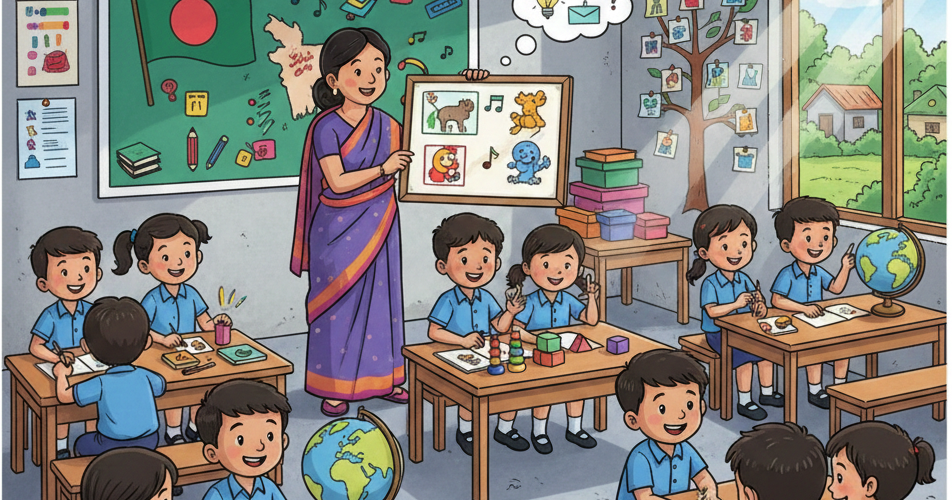
Learning is not just memorizing words or solving problems. It is a holistic process where children engage, understand, remember, and apply knowledge. In Bangladesh’s primary classrooms, teachers often face large class sizes, limited resources, and diverse student needs. To create meaningful learning experiences, teachers need to plan carefully, understand their students, and employ strategies that make learning interactive, enjoyable, and effective.
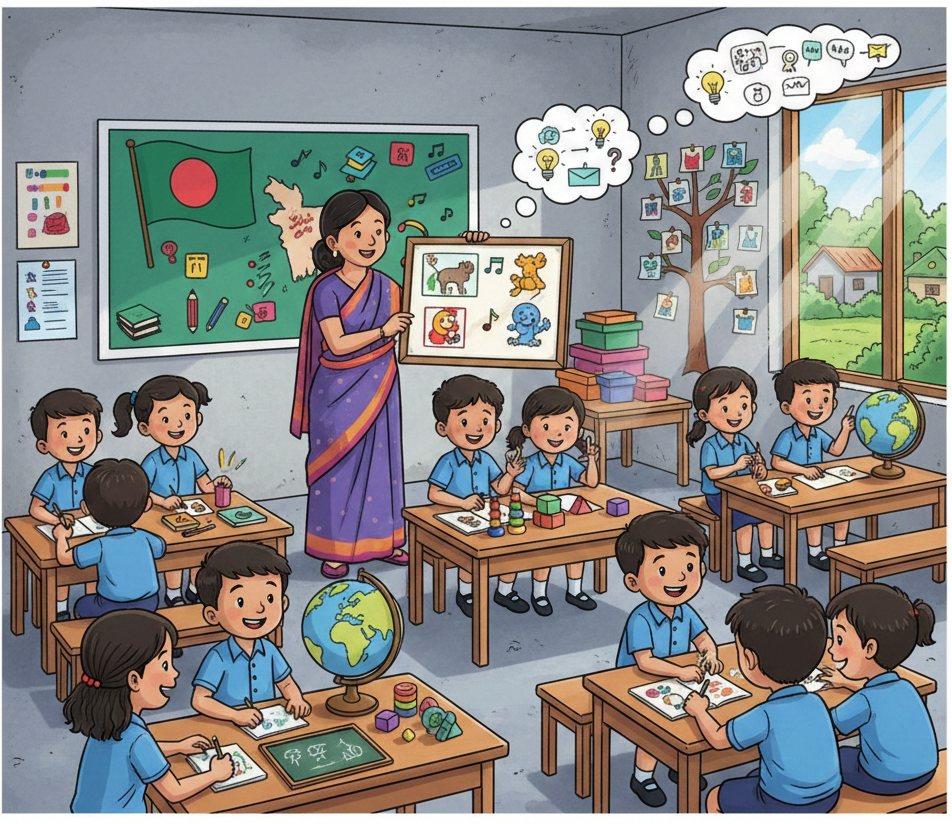
Here are detailed strategies for teachers to enhance learning in classrooms:
1. Set Clear Learning Goals
Why it matters:
Clear objectives help students understand the purpose of the lesson. Goals provide direction and motivation. When children know what they are aiming to learn, they become more focused and confident.
What to do:
- Define lesson objectives in measurable terms.
- Make goals realistic and achievable within the lesson duration.
- Relate goals to students’ prior knowledge.
Example:
“By the end of this lesson, students will be able to write five new words, pronounce them correctly, and use them in a simple sentence.”
Activities:
- Share the learning goal at the start of class.
- Ask children to write or draw their personal goals for the lesson.
- Review goals at the end of the lesson to celebrate achievement.
2. Understand Challenges and Limitations
Why it matters:
Each child learns at a different pace. Age, prior knowledge, language skills, attention span, and personal experiences affect learning. Recognizing these differences ensures no child feels left behind or overwhelmed.
What to do:
- Avoid setting overly ambitious targets.
- Break tasks into manageable steps.
- Adapt lessons to available time and resources.
Activities:
- Start with simpler examples and gradually increase difficulty.
- Observe students’ responses and adjust tasks accordingly.
- Conduct short formative assessments to check comprehension.
3. Multi-Sensory Learning
Why it matters:
Children remember better when lessons engage multiple senses. Using visual, auditory, and tactile experiences helps understanding and retention.
What to do:
- Incorporate storytelling, songs, rhymes, role-play, and hands-on activities.
- Use materials children can touch, manipulate, or explore.
Activities:
- Let children trace letters in sand, clay, or rice to practice writing.
- Use flashcards with images, colors, and textures.
- Conduct simple science experiments or cooking exercises to demonstrate concepts.
4. Chunking Information
Why it matters:
Large amounts of information can overwhelm young learners. Breaking content into smaller sections improves focus and memory.
What to do:
- Divide long lessons into 3–5 sections.
- Teach one section at a time, reinforcing it before moving on.
Activities:
- Split a long story into parts and discuss each part with questions.
- Group vocabulary or math problems into small sets for easier practice.
- Use short, frequent breaks to allow mental processing.
5. Interleaving
Why it matters:
Mixing different topics or problem types improves understanding and problem-solving skills. Children learn to identify patterns and differences, strengthening long-term retention.
What to do:
- Avoid teaching one type of problem repeatedly.
- Combine multiple topics in a single lesson.
Activities:
- Mix addition, subtraction, and word problems in math practice.
- Introduce new vocabulary words from various subjects together.
- Alternate between reading, writing, and speaking activities in language lessons.
6. Memory-Boosting Techniques (Mnemonics)
Why it matters:
Children often struggle to remember sequences, facts, or vocabulary. Mnemonics make memorization easier and more fun.
What to do:
- Use songs, rhymes, visual cues, or mental imagery.
- Encourage children to create their own memory aids.
Activities:
- Use color-coded flashcards for numbers, letters, or new words.
- Teach simple rhymes for days of the week, months, or multiplication tables.
- Ask students to draw pictures representing concepts to recall later.
7. Visualization
Why it matters:
Transforming abstract ideas into visual images helps children understand and remember complex concepts.
What to do:
- Use drawings, diagrams, charts, and maps.
- Encourage mental visualization of stories, events, or scientific phenomena.
Activities:
- Draw a simple diagram to explain a river, the water cycle, or a historical event.
- Ask children to close their eyes and imagine a scenario described in a story.
- Let students create their own visual representations of concepts.
8. Active Learning Strategies
Why it matters:
Children learn best when they participate actively. Active learning fosters critical thinking, collaboration, and problem-solving skills.
What to do:
- Include discussion, questioning, group work, and hands-on tasks.
- Relate lessons to real-life experiences.
Activities:
- Ask students questions after a story or lesson to assess comprehension.
- Organize group projects or peer teaching activities.
- Connect lessons to daily life, like counting money, measuring ingredients, or observing local plants.
9. Problem-Based Learning
Why it matters:
Real-world problems encourage children to analyze, explore solutions, and develop decision-making skills.
What to do:
- Use familiar situations or challenges as learning opportunities.
- Encourage research, critical thinking, and teamwork.
Activities:
- Discuss: “What should we do if our village faces water scarcity?”
- Assign small community-based projects, like planting a garden or keeping a cleanliness chart.
- Encourage children to propose multiple solutions and evaluate them.
10. Maintain Curiosity
Why it matters:
Curiosity motivates children to explore, question, and discover. It strengthens cognitive development and promotes lifelong learning.
What to do:
- Create a classroom culture where questions are encouraged.
- Introduce new topics, activities, or games to spark interest.
Activities:
- Have a “Question of the Day” corner where children post questions.
- Conduct small experiments or puzzles to stimulate curiosity.
- Encourage students to investigate answers through research or observation.
11. Adapt to Learning Styles
Why it matters:
Children learn differently—some prefer visual cues, others benefit from listening, movement, or hands-on activities. Matching teaching to learning styles improves engagement and outcomes.
What to do:
- Identify each child’s preferred learning style.
- Incorporate a variety of teaching methods.
Activities:
- Use images, videos, songs, hands-on experiments, role-play, or storytelling.
- Rotate activities so each style is addressed regularly.
- Observe which method helps each student understand and retain information best.
12. Combine All Strategies
Why it matters:
Using multiple strategies together strengthens learning. Children are more likely to understand, retain, and apply knowledge when lessons are dynamic and varied.
What to do:
- Integrate goal setting, chunking, interleaving, multi-sensory learning, memory techniques, curiosity, and active learning into every lesson.
- Review and reinforce lessons regularly to strengthen understanding.
Activities:
- Plan lessons where multiple strategies are used for each topic.
- Use reflection exercises to help students recall what they learned.
- Celebrate achievements to motivate continued engagement.
Conclusion
Effective learning is about clarity, engagement, and variety. Teachers in Bangladesh’s primary schools can transform classrooms by:
- Setting achievable goals,
- Recognizing student challenges,
- Using multi-sensory approaches,
- Encouraging curiosity and active participation.
When lessons are tailored to children’s learning styles and include hands-on, interactive methods, knowledge becomes meaningful and lasting. These strategies not only improve classroom outcomes but also foster critical thinking, problem-solving skills, and a lifelong love of learning.