Beyond Enrollment: Confronting the Hidden Barriers to Learning in Bangladesh’s Primary Schools
Abstract
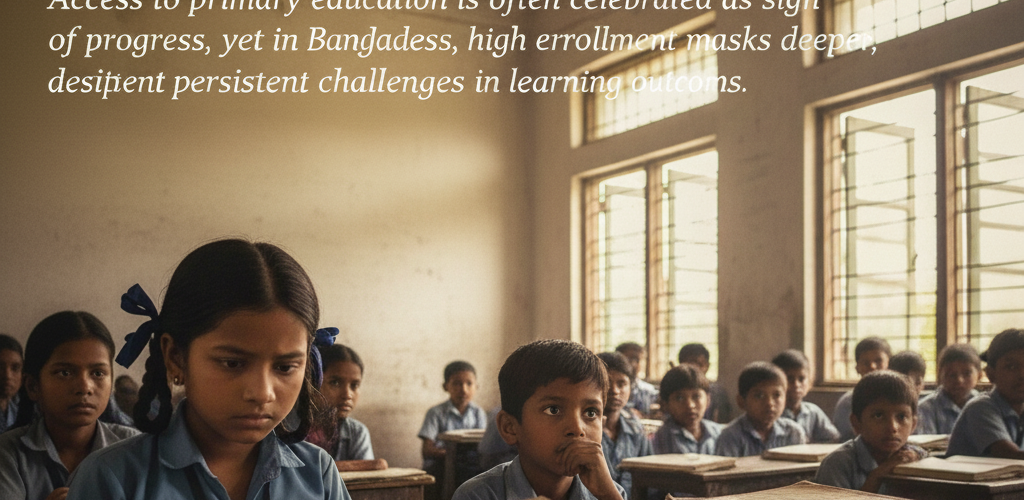
Access to primary education is often celebrated as a sign of progress, yet in Bangladesh, high enrollment masks deeper, persistent challenges in learning outcomes. The central question is not whether children are attending school, but whether they are acquiring the skills, knowledge, and confidence necessary to thrive in life and society. Despite nearly universal enrollment, many students complete primary education without achieving functional literacy, numeracy, or problem-solving abilities. This article critically examines the hidden barriers that impede meaningful learning, including economic pressures that drive dropout, overcrowded classrooms, curricula that emphasize memorization over understanding, gendered social expectations, environmental disruptions, and unequal access to digital resources. Drawing on evidence from BANBEIS, UNICEF, PPRC, and other sources, the study highlights the persistent gap between educational access and learning quality. It argues that achieving genuine educational progress requires moving beyond enrollment statistics to address systemic, social, and structural constraints. Policy and practice interventions recommended include teacher capacity development, competency-based curriculum reform, infrastructure improvements, gender-sensitive strategies, climate resilience planning, and bridging the digital divide. By confronting these challenges, Bangladesh can transform enrollment achievements into education that is both inclusive and effective, ensuring children are truly prepared for the opportunities and challenges of the twenty-first century.
Introduction
Bangladesh’s progress in expanding primary school enrollment over the past decades is widely acknowledged. From the early 2000s to the present, government initiatives, community mobilization, and international support have collectively raised access to education to nearly universal levels. At first glance, these statistics are encouraging. Enrollment is often equated with success, celebrated in policy reports, media narratives, and international development forums. However, a closer examination reveals a critical distinction between access and learning. Attending school does not automatically translate into acquiring skills, knowledge, and competencies that children can apply in their daily lives or future work.
This disparity invites a fundamental question: what does educational progress truly mean? If children are present in classrooms yet fail to read fluently, solve basic arithmetic problems, or apply reasoning skills, then enrollment alone is insufficient. The challenge lies in understanding the hidden barriers that compromise learning, which often include a combination of economic hardship, infrastructural deficiencies, weak pedagogical practices, social pressures, environmental risks, and digital exclusion. These obstacles are deeply intertwined, creating an education landscape where surface-level indicators of success mask persistent inequalities and inefficiencies.
This article aims to critically examine the gap between enrollment and meaningful learning in Bangladesh’s primary education system. Drawing on the latest government data, research studies, and media reports, it explores the multifaceted challenges that hinder quality education and proposes actionable strategies to address them. The analysis emphasizes that achieving equitable and effective learning requires systemic reforms that go beyond access, focusing on the quality, inclusivity, and resilience of the education system.
Enrollment and the Illusion of Progress
While Bangladesh boasts impressive enrollment figures, learning assessments suggest that many students do not achieve the foundational competencies expected at each grade level. Reports from BANBEIS, national assessments, and UNICEF-supported studies indicate that a significant proportion of Grade 5 students struggle with basic reading and arithmetic. This reality exposes the limitations of using enrollment as a proxy for educational success.
Focusing on enrollment alone can lead to policy complacency. Schools may prioritize registration campaigns, construction of new classrooms, and distribution of textbooks while overlooking whether children are actually learning. In practice, enrollment reflects the potential for education rather than its realization. The challenge for Bangladesh, therefore, is to translate access into meaningful outcomes, ensuring that children acquire the knowledge and skills necessary to participate fully in society.
Economic Pressures and Rising Dropout Rates
Economic vulnerability remains a primary driver of dropout in primary education. Recent data from BANBEIS (2025) shows that the primary school dropout rate increased from 13.15 percent in 2023 to 16.25 percent in 2024. Concurrently, the Power and Participation Research Centre (PPRC, 2025) reports a rise in national poverty to 27.93 percent in 2025, up from 18.7 percent in 2022. Families experiencing financial insecurity often prioritize immediate income over education, resulting in children leaving school to support household livelihoods.
These economic pressures disproportionately affect boys and girls in different ways. Boys are more likely to leave school for wage labor, while girls face domestic responsibilities and the risk of early marriage, which remains high according to UNICEF (2021). These patterns illustrate that educational retention is deeply influenced by socio-economic factors, underscoring the need for policies that integrate education with social protection measures.
Infrastructural Challenges and Overcrowded Classrooms
Physical infrastructure in primary schools has not kept pace with enrollment growth. Reports indicate that approximately 80 percent of government primary schools operate on a double-shift basis, leaving classrooms overcrowded and instructional time compressed. Student-teacher ratios often exceed recommended standards, with some classes accommodating 40 to 50 students per teacher.
Overcrowding diminishes opportunities for individualized instruction, formative feedback, and meaningful classroom interaction. Beyond classroom density, inadequate sanitation, insufficient ventilation, and unsafe buildings negatively affect attendance and learning outcomes. Without infrastructure improvements, high enrollment risks becoming a quantitative achievement rather than a qualitative success.
Curriculum Limitations and Assessment Practices
Curriculum design and assessment practices significantly shape learning experiences. In January 2025, the interim government reverted to the 2012 national curriculum, highlighting instability in educational policy. Frequent revisions without adequate teacher training disrupt classroom continuity and compromise learning quality.
Furthermore, the curriculum continues to prioritize memorization over comprehension, critical thinking, and practical application. Assessments focus on factual recall rather than problem-solving or analytical skills, reinforcing a culture of rote learning. Such practices limit the development of higher-order cognitive skills, leaving students ill-prepared for further education or real-life challenges.
Gender Inequalities and Social Pressures
Gender disparities remain a central concern in primary education. Over 50 percent of Bangladeshi girls marry before adulthood, as reported by UNICEF (2021), leading to school dropout and limited life opportunities. Social expectations around domestic labor further restrict girls’ time and energy for study. Boys, conversely, may leave school to contribute economically, reflecting gendered expectations around labor.
These dynamics highlight that enrollment parity does not necessarily translate into equitable learning. Addressing gendered barriers requires targeted interventions, including community awareness, flexible learning opportunities, legal protections against early marriage, and supportive school environments.
Climate Disruptions and Education
Bangladesh is highly vulnerable to climate-related disruptions. In April 2024, temperatures reached 43 degrees Celsius, prompting nationwide school closures (Reuters, 2024). Floods, cyclones, and riverbank erosion further interrupt school schedules and damage infrastructure. Children in rural or low-income areas are most affected, often losing weeks of instruction with limited alternatives.
Building climate resilience into education requires both structural and operational strategies, including resilient school facilities, contingency learning plans, and integration of disaster preparedness into the curriculum.
Digital Divide and Unequal Access
Technology offers new learning opportunities, but unequal access to digital tools exacerbates educational disparities. The Centre for International Education and Development (CIES, 2023) notes that many students and teachers lack devices, reliable electricity, or internet connectivity. Urban and private school students disproportionately benefit, while rural and disadvantaged children face exclusion.
Digital learning can support but not replace foundational classroom education. Equitable access, offline learning materials, and teacher training are essential for ensuring that digital interventions enhance, rather than undermine, learning opportunities.
Policy and Practice Recommendations
To address these interconnected barriers, a comprehensive approach is needed:
- Teacher Capacity Development: Invest in professional training focused on active learning, critical thinking, and socio-emotional support.
- Competency-Based Curriculum Reform: Shift from rote memorization toward skills-based, problem-solving-oriented learning.
- Infrastructure Enhancement: Expand single-shift schooling, reduce class sizes, and improve sanitation and safety.
- Gender-Sensitive Interventions: Promote retention of girls through legal protections, community engagement, and flexible schooling options.
- Climate Resilience: Build infrastructure capable of withstanding environmental shocks and develop contingency learning plans.
- Digital Inclusion: Ensure access to devices, connectivity, and teacher support for equitable technology integration.
- Community Engagement: Involve parents and local stakeholders to reinforce the value of education and retention strategies.
Conclusion
Bangladesh’s success in expanding primary school enrollment is commendable, but enrollment alone does not guarantee meaningful learning. Rising dropout rates, overcrowding, curriculum instability, gendered social pressures, climate disruptions, and unequal digital access continue to impede educational quality. Addressing these challenges requires systemic, evidence-informed reforms that prioritize learning outcomes over attendance figures. By investing in teacher capacity, infrastructure, gender equity, climate resilience, and digital inclusion, Bangladesh can transform enrollment achievements into education that equips all children with the skills, knowledge, and confidence to thrive in society. Only through such a holistic approach can the promise of universal education translate into sustainable, equitable learning outcomes.
References
BANBEIS. (2025). Annual Primary School Statistics (APSS) 2024. Bangladesh Bureau of Educational Information and Statistics. Retrieved from https://newsclipping.banbeis.gov.bd/sites/default/files/downloads/144106.pdf
Bangladesh Bureau of Statistics (BBS). (2025). Poverty Map of Bangladesh 2022. National Strategy for Development Statistics. Retrieved from https://nsds.bbs.gov.bd/en/topic/52/Poverty
The Daily Star. (2025, March 15). Bangladesh Needs Better Education Infrastructure to Prevent Primary Dropouts. Retrieved from https://www.thedailystar.net/opinion/views/news/bangladesh-needs-better-education-infrastructure-prevent-primary-dropouts-3977821
Reuters. (2024, April 29). Bangladesh Shuts Schools Again with No Let-Up in Heatwave. Retrieved from https://www.reuters.com/world/asia-pacific/bangladesh-again-shuts-schools-d