How Embedding Social Emotional Learning in Mathematics, Science, and Language Transforms Student Achievement and Emotional Regulation
In classrooms around the world, educators are confronting a paradox. On the one hand, the pressure to raise academic achievement continues to intensify, with standardized tests and rigid curricula prioritizing cognitive mastery. On the other hand, societies increasingly understand that academic success alone is inadequate preparation for a world defined by complexity, uncertainty, collaboration, and rapid change. The competencies that enable individuals to understand and manage their emotions, communicate effectively with others, collaborate across differences and solve complex problems are no longer optional. They are essential.
This realization has propelled a shift in educational thinking toward Social Emotional Learning (SEL), but the traditional way of delivering SEL, as a stand‑alone subject or periodic lesson ; fails to harness its full potential. Instead what research and informed practice now show is that embedding SEL directly within core subjects such as mathematics, science, and language instruction produces stronger and more sustainable gains across academic outcomes, problem solving, and emotional regulation.
This article explores why embedding SEL within core academic content matters, how it works in practice across disciplines, what evidence supports its impact, and what this means for teaching, learning, and educational policy. The goal is to articulate a clear and compelling case for integration that is rooted in research and classroom experience and that speaks directly to educators, administrators, and policy thinkers.
Reframing the Purpose of Schooling: Academic Learning and Emotional Development as One
For decades, conventional schooling separated cognitive development from emotional and social growth. Academic subjects focused on knowledge and skills while informal interventions, advisories, or separate SEL lessons took up emotional and social concerns. This model treats the cognitive and emotional as parallel tracks rather than interconnected parts of the same learning process.
Cognitive science has made clear that this separation is artificial. Emotions influence attention, memory, executive function, motivation, and reasoning; all of which are central to learning. Students who can regulate their anxiety and frustration are more likely to sustain effort on challenging tasks. Those who communicate effectively collaborate more productively in group problem solving. Those who understand their own emotional responses are better equipped to interpret complex language texts.
Social emotional learning therefore is not an optional enrichment. It is a fundamental dimension of how people learn deeply. Research firmly establishes that SEL positively influences academic performance, behavior, emotional wellbeing, and school connectedness. A landmark meta‑analysis involving more than two hundred thousand students found that SEL programs are associated with significant improvements in social and emotional competencies, positive behaviors and academic performance at school compared to peers who did not receive SEL support. Participants in SEL interventions demonstrated meaningful gains on achievement measures with an average increase corresponding to an eleven percentile point gain relative to controls in academic performance. These gains are observed across contexts urban, suburban, and rural and are evident even six months after interventions conclude. SEL delivered by classroom teachers as part of routine practice is effective without requiring external specialists.
A more recent meta‑analytic review focusing on students from elementary and middle grades confirms these positive effects across core subjects. SEL interventions yielded positive effects on overall academic performance and showed measurable gains in mathematics, English language arts, and science. Specifically the review reported positive effect sizes for outcomes in mathematics, English language arts, and science, indicating that SEL contributes meaningfully to academic success in these subjects when it is integrated within learning environments rather than isolated.
In light of this evidence, the question for educators must be not whether to integrate SEL but how to embed it intelligently so that the development of emotional competence, social awareness, and self regulation enriches core curriculum instruction rather than interrupting it.
The Mechanics of Embedding SEL in Core Subjects
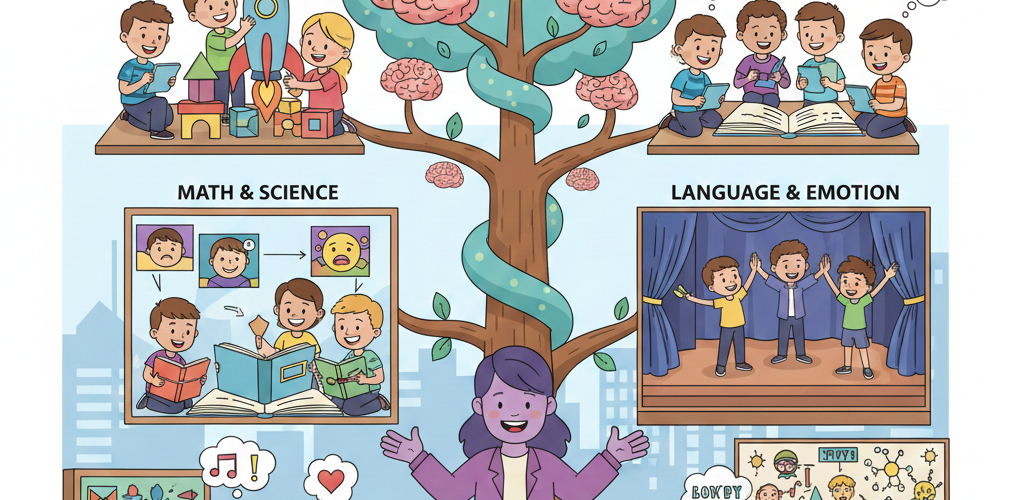
Embedding SEL in mathematics, science, and language is not about inserting stand‑alone emotional skill lessons into academic schedules. It involves intentional lesson design that cultivates emotional and social competencies within the intellectual demands of subject matter. In this integrated model emotional challenges are not distractions from learning but integral opportunities for growth.
Effective integration rests on three core principles:
First, design learning experiences that simultaneously cultivate cognitive and emotional engagement. Tasks should require curiosity, reflection, persistence, perspective taking, and collaboration.
Second, use opportunities naturally embedded in subject content to foster emotional regulation, interpersonal understanding, and responsible decision making.
Third, equip teachers with the pedagogical tools and professional judgment to create classroom climates that support risk taking, respectful dialogue, error analysis, and shared responsibility for learning.
The following sections examine how SEL integration unfolds in mathematics science, and language instruction and how it affects learning outcomes, problem solving, and emotional regulation.
Mathematics and Social Emotional Learning: Turning Anxiety into Growth
For many students mathematics evokes stress, fear of failure, and avoidance. Research into mathematics education consistently links negative emotional responses such as anxiety and fixed beliefs about ability with reduced engagement and diminished performance. But when SEL competencies are woven into mathematics instruction, emotional barriers become gateways to deeper understanding.
In mathematics classrooms where SEL is integrated the focus shifts from performance alone to process engagement. Students work collaboratively on rich, non‑routine problems that require explanation, justification, and negotiation of solutions. These collaborative tasks engage students cognitively while requiring them to communicate reasoning, listen to peers, and resolve differences in approach. This practice directly builds relationship skills, social awareness, and responsible decision making as students learn to articulate their thinking and respond constructively to others.
A multiple case study of an SEL‑infused mathematics curriculum illustrates how this works in practice. In classrooms implementing an integrated approach students experienced supportive feedback invitations to participate and normalisation of mistakes. Teachers reported reduced math anxiety and greater confidence, and students exhibited improved engagement cooperation and resilience in problem solving situations. These emotionally supportive environments did not detract from academic rigor; instead they created conditions where students could persist through difficulty and focus on conceptual understanding rather than fear of error.
Reflective practices such as academic journaling further strengthen SEL integration in mathematics. When students are asked to reflect on the strategies they used, the emotions they encountered, and how they coped with uncertainty, they develop meta cognitive awareness that fosters both emotional regulation and mathematical reasoning. Reflection prompts might ask students to describe what frustrated them, which strategies worked, and how they managed feelings of confusion. This nurturing of reflective habits turns each mathematical struggle into a learning opportunity rather than a threat to self‑worth.
Teachers also play a pivotal role by modelling emotional regulation. When educators verbalize their thinking, including how they navigate their own uncertainty, they demonstrate to students that difficulty is part of the learning process. They normalise challenges and help students develop a growth orientation where persistence and strategic adjustment are valued.
In these ways SEL supports mathematics learning by reducing anxiety, enhancing collaboration, and fostering confidence in problem solving. Students are not merely memorising algorithms; they are learning how to think, how to work with others, and how to manage the emotions that accompany deep cognitive effort.
Science and Social Emotional Learning: Cultivating Inquiry, Resilience, and Ethical Understanding
Science education inherently involves inquiry, interpretation of evidence, experimentation, and synthesis of information. Successful engagement with scientific tasks requires students to navigate uncertainty, revise hypotheses, collaborate with peers, and interpret complex data. These are not only cognitive challenges but social and emotional ones as well.
Embedding SEL in science instruction begins by positioning emotional and social competencies as integral to inquiry. Collaborative science projects often require negotiation of roles, sharing of resources, collective problem solving, and communication of ideas. This social interaction fosters relationship skills and social awareness. When students are guided to articulate their reasoning, respond respectfully to differing views, and build consensus, they practice competencies that extend far beyond disciplinary content.
A critical aspect of SEL integration in science is the management of frustration and uncertainty. Experiments do not always yield expected results. Traditional instruction can frame this as failure, discouraging persistence. However an SEL‑infused classroom views unexpected outcomes as opportunities for reflection and learning. Educators intentionally cultivate resilience by inviting students to analyse what went wrong, what was learned, and how to proceed differently. Structured reflection prompts may include discussion of emotional reactions to unexpected results, strategies used to cope, and how collaborative dialogue influenced understanding.
Such reflective practices strengthen emotional regulation as students learn to decouple setbacks from personal inadequacy. They develop resilience in the face of ambiguity and build confidence in their capacity to engage in scientific reasoning. This resilience transfers to other contexts, supporting students in high stakes assessments, complex problem solving, and real world decision making.
Another dimension of SEL integration in science involves connecting scientific content to ethical and societal implications. Discussions about environmental impact, health disparities, technological change, and sustainability require students to exercise social awareness and responsible decision making. These conversations deepen scientific understanding while inviting students to consider diverse perspectives and the values inherent in scientific application.
Teachers implementing SEL in science create classroom climates that value inquiry and reflection. They establish norms for respectful dialogue, encourage evidence based reasoning, and guide students to interpret their own emotional responses to challenge. In doing so they nurture scientific competence alongside emotional and social maturity.
Language and Social Emotional Learning: Building Expression, Interpretation, and Empathy
Language instruction, particularly through literature and writing, presents rich opportunities for SEL integration because it inherently involves interpretation of meaning, expression of ideas, and interpersonal communication. Language classrooms are natural sites for exploration of emotion, perspective taking, and relational understanding.
Embedding SEL in language begins with reflective writing. Students are encouraged to connect content with personal experience and emotional insight. For example when reading a novel they might reflect on how a character’s dilemma resonates with their own life, how certain emotions influence decision making, or how language expresses nuanced feelings. Such reflection fosters self awareness and emotional literacy, strengthening students’ ability to identify, interpret, and articulate internal experiences in relation to texts.
Discussion based learning is another essential component of SEL‑integrated language instruction. Structured discourse invites students to articulate interpretations, listen to diverse viewpoints, and negotiate meaning. Norms for active listening, respectful challenge, and evidence based reasoning help students practice relationship skills, social awareness, and responsible decision making. When students learn to speak and listen with intention they develop confidence and communication skills that support both academic and social outcomes.
Collaborative writing projects further enrich SEL integration. Teams of students co create narratives, essays, or multimedia presentations, requiring coordination, mutual support, and negotiation of ideas. These tasks cultivate relationship skills such as collaboration, feedback exchange, conflict resolution, and shared responsibility. Students learn to manage interpersonal dynamics while focusing on linguistic and rhetorical goals.
Drama, role play, and storytelling activities amplify SEL integration by putting students in emotional and relational contexts that require perspective taking. Embodying characters, responding to imagined dilemmas, and negotiating dialogue help students practice empathy and emotional expression. These embodied experiences deepen comprehension while strengthening students’ capacity to interpret and communicate nuanced emotional content.
Evidence from research shows that SEL integration in language instruction enhances comprehension, critical thinking, empathy, and perspective taking. Students who engage in reflective writing, structured discussion, and collaborative projects demonstrate improved ability to interpret texts from multiple perspectives, articulate ideas convincingly and communicate with empathy and clarity. These competencies are essential not only for academic success but also for mature social engagement.
Academic Outcomes: Engagement, Persistence, and Achievement
When social emotional learning is embedded within core subjects the effects on academic outcomes are measurable and meaningful. Meta analytic evidence demonstrates that SEL interventions contribute positively to achievement in mathematics, English language arts, and science. The meta analysis of studies involving elementary and middle school students reported positive effects across these subjects and significant improvements in overall academic performance when SEL programming was present.
Students in SEL‑integrated classrooms exhibit higher engagement. Engagement encompasses behavioral facets such as participation and effort, cognitive aspects such as attention and strategy use, and emotional qualities such as interest and enjoyment of learning activities. When students feel emotionally supported and connected to classroom tasks they are more likely to participate actively, sustain effort through challenge, and persevere in the face of difficulty.
Academic persistence is a critical mediator of achievement. Students equipped with emotional regulation and resilience are more likely to approach difficult tasks with curiosity rather than avoidance. They are willing to iterate on solutions, engage in productive struggle, and ask for help when needed. Reflection on emotional responses helps students understand their motivational patterns and monitor their own learning, contributing to meta cognitive growth.
Importantly, integration does not dilute academic content. Rather it enhances comprehension and conceptual understanding by making learning experiences more accessible, relevant, and meaningful. Students are not memorising isolated facts but are developing cognitive and emotional strategies that support deep and adaptable learning.
Problem Solving as a Shared Outcome of SEL and Academic Integration
Problem solving is central to education. It requires students to identify problems, generate potential solutions, evaluate options, and implement decisions. Effective problem solving involves cognitive reasoning, creativity, persistence, and strategic use of information. SEL competencies support each of these elements.
Self awareness enables students to recognise emotional responses such as anxiety or frustration that may hinder cognitive processing. Self management allows students to regulate these emotions, sustaining focus on task strategies rather than self judgments. Social awareness and relationship skills are especially important when problem solving involves collaboration, requiring constructive communication, shared interpretation of information, and joint decision making. Responsible decision making supports ethical evaluation of solutions and consideration of consequences.
Research on SEL in school contexts shows that students who receive SEL support demonstrate superior problem solving abilities relative to peers who do not. These students approach problems with greater flexibility, are more willing to revise strategies based on feedback, and integrate diverse viewpoints when working collaboratively. Embedding SEL in science and mathematics instruction situates problem solving within authentic, content rich contexts where cognitive and emotional competencies are exercised together. This integrative practice strengthens students’ confidence in tackling novel and complex challenges.
Emotional Regulation: The Heart of Integrated Learning
Emotional regulation is the capacity to monitor, evaluate and adjust emotional reactions in adaptive ways. In academic contexts where challenge, ambiguity, and social interaction are constant, emotional regulation is essential. Poor emotional regulation may lead to anxiety avoidance and disengagement. Strong emotional regulation supports resilience, sustained effort, and adaptive responses to setbacks.
SEL integrated into mathematics teaches students to recognise frustration and use strategies such as pausing, reframing the problem or seeking help. In science, students learn to view unexpected results as opportunities for refinement and inquiry rather than as failures. In language classrooms students learn to navigate emotional responses to interpretation, debate, and peer feedback.
Empirical research establishes that students in SEL enhanced learning environments exhibit lower levels of school related anxiety, greater confidence and adaptability. These emotional competencies extend beyond individual subjects contributing to overall psychological wellbeing and positive school experiences. Emotional regulation cultivated within the academic learning process transfers to broader life contexts, enabling students to respond constructively to stress and complexity in and beyond school.
Implementation: Practical Strategies for Teachers and Schools
Embedding SEL in core subjects requires intentional instructional design, professional learning and supportive assessment practices.
Instructional Design:
Teachers should articulate clear objectives that combine content standards with SEL competencies. Lesson plans must include collaborative tasks, reflective prompts and authentic opportunities for students to practise emotion regulation and interpersonal skills.
Classroom Norms:
Establish norms for respectful communication, active listening and constructive feedback. These norms create safe environments where students feel comfortable taking intellectual risks and expressing ideas.
Professional Learning:
Continuous professional development is essential. Teachers need support in facilitating emotionally supportive discussions managing group dynamics and reflecting on their own emotional practices within instruction.
Assessment:
Assessment practices should capture both academic and SEL outcomes. Observation protocols, reflective journals, student self assessments and performance tasks provide data on how students apply social emotional competencies while learning subject content.
Institutions can support integration by providing time for collaborative planning, resources for inquiry based tasks, and curricular flexibility. Policymakers can reinforce SEL integration by linking SEL competencies with subject standards and accountability frameworks.
Challenges and the Road Ahead
Despite strong evidence for SEL integration, challenges remain. Time constraints, rigid curricula, limited teacher preparation, and high stakes testing pressure can undermine efforts. Cultural differences in expressions of emotion and communication styles require sensitive and context responsive adaptations. Measurement of SEL outcomes is complex, and educators must use mixed methods to capture authentic learning experiences.
Future research should continue to investigate long term effects of SEL integration across varied educational settings and populations. Studies must explore how cultural, socioeconomic, and developmental contexts influence SEL outcomes and identify scalable models for under-resourced schools. Longitudinal research designs and diverse data sources will deepen understanding of how SEL integration affects life trajectories beyond immediate academic performance.
Conclusion: A Vision of Integrated Learning for a Complex World
Embedding social emotional learning within mathematics, science and language instruction represents a shift from fragmented schooling to holistic education. Rather than treating cognitive and emotional development as separate strands, integrated SEL recognizes that meaningful learning arises from their synergy. Students who learn to manage emotions, communicate with clarity, collaborate with peers and solve complex problems become not only stronger academically but also more resilient, confident and adaptive citizens.
This integration transforms classrooms into inclusive environments where intellectual challenge and emotional growth coexist. Students learn not just what to think but how to think and how to feel in the pursuit of understanding. Teachers become not only transmitters of content but facilitators of growth, guiding students through the interplay of thought and emotion.
As education systems evolve to meet twenty-first century demands, embedded SEL offers a pathway for cultivating learners equipped for complexity, uncertainty and social responsibility. By weaving emotional and social competencies into the fabric of core academic subjects educators can nurture not only cognitive achievement but the whole child ready to thrive in a rapidly changing world.
References
Corcoran, R. P., Valdes, E., & Schneider, S. (2018). Effective universal school‑based social and emotional learning programs for improving academic achievement: A systematic review and meta‑analysis of 50 years of research. Educational Research Review, 25, 56‑72. https://doi.org/10.1016/j.edurev.2017.12.001
Broader SEL Academic Effects: Provides a long‑term historical review showing SEL’s positive effects on reading, math, and science achievement across decades of research.
Durlak, J. A., Weissberg, R. P., Dymnicki, A. B., Taylor, R. D., & Schellinger, K. B. (2011). The impact of enhancing students’ social and emotional learning: A meta‑analysis of school‑based universal interventions. Child Development, 82(1), 405‑432. https://doi.org/10.1111/j.1467‑8624.2010.01564.x
SEL Meta‑Analytic Evidence: Shows that SEL programs with over 270,000 students produce significant social, emotional, and academic gains, including an average 11 percentile point increase in achievement compared to controls.
Elias, M. J., Zins, J. E., Weissberg, R. P., Frey, K. S., Greenberg, M. T., Haynes, N. M., Kessler, R., Schwab‑Stone, M. E., & Shriver, T. P. (1997). Promoting social and emotional learning: Guidelines for educators. Association for Supervision and Curriculum Development.
Conceptual and Theoretical Foundations: Provides foundational guidance on SEL competencies, integration with academic learning, and school implementation strategies.
Ha, C., McCarthy, M. F., Strambler, M. J., & Cipriano, C. (2025). Disentangling the effects of social and emotional learning programs on student academic achievement across grades 1–12: A systematic review and meta‑analysis. Review of Educational Research. https://doi.org/10.3102/00346543251367769
Extended Grades Review: Confirms SEL’s positive effects on overall academic performance across grades 1–12 and enhanced standardized achievement measures.
Jennings, P. A., & Greenberg, M. T. (2009). The prosocial classroom: Teacher social and emotional competence in relation to student and classroom outcomes. Review of Educational Research, 79(1), 491‑525.
Conceptual and Theoretical Foundations: Highlights teacher SEL competence, classroom climate, and how these influence student learning, behavior, and emotional outcomes.
Payton, J., Weissberg, R. P., Durlak, J. A., Dymnicki, A. B., Taylor, R. D., Schellinger, K. B., & Pachan, M. (2008). The positive impact of social and emotional learning for kindergarten to eighth‑grade students: Findings from three scientific reviews. Collaborative for Academic, Social, and Emotional Learning.
Conceptual and Theoretical Foundations: Offers evidence of SEL benefits for K–8 students and theoretical grounding for integration with academic content.
Zhao, Y., & Sang, B. (2025). The effect of social-emotional learning programs on elementary and middle school students’ academic achievement: A meta-analytic review. Behavioral Sciences, 15(11), Article 1527. https://doi.org/10.3390/bs15111527
Subject‑Specific Academic Gains: Documents positive effects of SEL on mathematics, English language arts, science, and GPA in elementary and middle school students.
Zins, J. E., Weissberg, R. P., Wang, M. C., & Walberg, H. J. (2004). Building academic success on social and emotional learning: What does the research say? Teachers College Press.
Conceptual and Theoretical Foundations: Establishes links between SEL, cognitive development, academic achievement, and student well‑being.