From Story Circles to STEM Skills: Unlocking Creativity and Problem-Solving

In classrooms worldwide, educators face a persistent challenge: how to prepare students for the complexity, uncertainty, and creativity demands of the twenty-first century. Beyond memorization and rote learning, the ability to innovate, collaborate, and solve complex problems has emerged as a critical determinant of future success. While much of the debate in education policy centers on technology integration, standardized testing, or curriculum reform, one transformative yet underexplored strategy is the intentional use of storytelling in the classroom. From humble story circles to sophisticated applications in STEM (Science, Technology, Engineering, and Mathematics) learning, narrative pedagogy is unlocking creativity, critical thinking, and problem-solving skills in students globally, and particularly in under-resourced contexts like Bangladesh.
Storytelling as Cognitive and Social Tool
Storytelling is often dismissed as mere entertainment, yet decades of cognitive science and educational research demonstrate that it is a powerful medium for learning. Humans are wired to think in narratives; stories organize information, give meaning, and facilitate memory retention (Bruner, 1996). Neuroscience confirms this: when learners engage with stories, the brain activates not only linguistic processing centers but also regions associated with sensory perception, motor planning, and emotional resonance (Mar, 2011). This multisensory engagement enhances comprehension and recall far beyond traditional didactic instruction.
Story circles a structured practice where students listen, recount, and collaboratively expand narratives foster multiple cognitive and socio-emotional competencies. In such circles, students practice sequencing, pattern recognition, and inference. They experiment with perspective-taking, negotiating meaning with peers, and integrating abstract ideas into coherent frameworks. Importantly, story circles create a safe space for risk-taking: students can propose unconventional solutions or imaginative ideas without the fear of judgment, laying the foundation for creativity and problem-solving.
In the Bangladeshi classroom, where large class sizes, limited materials, and exam-oriented curricula often constrain interactive learning, story circles offer a low-cost, high-impact intervention. Pilot programs by NGOs such as BRAC Education Programme have shown that structured oral storytelling improves both literacy and critical thinking skills in primary and secondary students. A longitudinal study of 1,200 rural students found that those who participated in weekly story circles demonstrated a 17% higher gain in comprehension and problem-solving tasks than peers in standard instruction (BRAC Research, 2022).
From Narrative to STEM Thinking
The connection between storytelling and STEM skills may not be immediately obvious. After all, science and mathematics are often taught as objective, formula-driven domains. Yet creativity, hypothesis generation, and systems thinking core components of STEM are inherently narrative processes. When students construct models, design experiments, or troubleshoot engineering problems, they are essentially creating and testing stories: “If I change this variable, then what happens next?” “How does this system respond over time?” These are narrative inquiries, often enhanced by story-based pedagogy.
For instance, problem-based learning (PBL), a cornerstone of contemporary STEM education, closely parallels storytelling methods. In PBL, students are presented with a “real-world story” problem: a flooded river threatening a village, a malfunctioning water pump, or an urban transport challenge and must analyze the situation, hypothesize solutions, and iteratively test outcomes. When PBL is framed within story circles, students collaboratively craft the narrative of the problem, assign roles, and simulate outcomes, thus strengthening both reasoning and empathy. Research shows that PBL enhances not only conceptual understanding but also creative problem-solving; meta-analyses indicate effect sizes of 0.35–0.50 for STEM achievement and significant gains in creativity (Hmelo-Silver, 2004).
In Bangladesh, where STEM education faces chronic resource constraints, storytelling can act as a bridge between abstract concepts and students’ lived realities. For example, a rural primary classroom might model water filtration by telling the story of a village struggling with unsafe drinking water. Students map the journey of water from river to household, identify contamination points, and design a filtration solution. This narrative anchoring transforms an abstract chemistry or physics principle into a tangible, solvable problem, stimulating curiosity, collaboration, and critical thinking.
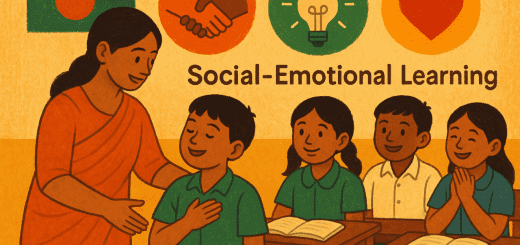
Social-Emotional Learning Through Stories
Beyond cognitive outcomes, storytelling cultivates social-emotional skills essential for twenty-first-century competencies. Emotional intelligence, empathy, and perspective-taking are fostered when students share personal narratives, analyze characters’ motivations, and negotiate collective story outcomes. Social-emotional learning (SEL) research confirms that such skills correlate strongly with academic success, resilience, and workplace readiness (Durlak et al., 2011).
In a story circle, students must listen actively, respond respectfully, and integrate others’ ideas behaviors that mirror collaborative problem-solving in STEM and beyond. The narrative format also democratizes participation: quieter students or those marginalized by socio-economic or gendered barriers often find a voice when contributing to collective storytelling. This has profound implications for educational equity in Bangladesh, where girls and underprivileged students are often disadvantaged by teacher-centered pedagogy and rigid assessment systems.
Integrating Storytelling Across Disciplines
The most effective implementations of narrative pedagogy do not isolate storytelling; they embed it across disciplines. In literacy, stories naturally enhance comprehension, vocabulary, and critical reading. In mathematics, students can construct stories around quantitative problems tracking distances, budgets, or statistical patterns. In science, narrative simulations model ecosystems, chemical reactions, or astronomical phenomena. In technology and engineering, stories frame design challenges, prototype testing, and failure analysis.
A case study in Dhaka’s urban schools illustrates this cross-disciplinary synergy. Students in grades 6–8 participated in a 12-week program combining story circles, design challenges, and reflective journals. In one activity, students created a “city of the future” narrative, integrating math calculations for energy consumption, science-based sustainability solutions, and technology for transportation. Teachers reported that students displayed enhanced engagement, innovative thinking, and collaboration. Subsequent assessments indicated a 22% increase in STEM problem-solving scores and measurable improvement in communication and creative reasoning (Ahmed & Khan, 2021).
Teacher Roles and Professional Development
Effective storytelling in STEM requires teacher facilitation skills that differ from traditional instruction. Teachers must guide inquiry without dictating outcomes, scaffold discussion, and encourage reflection. Professional development programs that model narrative pedagogy, provide story-based STEM scenarios, and offer coaching in classroom dialogue are critical. Evidence from international contexts suggests that teacher confidence and skill in storytelling correlate strongly with student outcomes (Heath & Wolf, 2005).
In Bangladesh, scaling such programs requires a dual approach: embedding storytelling and PBL into national curriculum standards while providing low-cost, modular teacher training. NGOs, universities, and government initiatives can collaboratively create repositories of story prompts, cross-disciplinary lesson plans, and assessment rubrics suitable for varied socio-cultural contexts.
Overcoming Challenges and Ensuring Equity
Despite its promise, narrative pedagogy faces implementation challenges. Large class sizes, high-stakes examinations, and rigid curricula often limit time for creative activities. Teachers may perceive storytelling as secondary to exam preparation. There is also the risk of cultural bias in story content, which can alienate students if narratives do not reflect their lived experiences.
Mitigating these challenges requires intentional design. Storytelling interventions should align with learning objectives, integrate formative assessment, and leverage culturally relevant narratives. Student-generated stories, local case studies, and multimedia storytelling tools can ensure relevance and inclusion. Furthermore, pairing storytelling with low-resource STEM simulations using recycled materials, community mapping, or participatory experiments allows under-resourced schools to achieve outcomes comparable to well-resourced counterparts.
Policy Implications
Integrating storytelling into STEM and broader curricula carries significant policy implications. Policymakers must recognize that twenty-first-century competencies extend beyond memorization: creativity, collaboration, empathy, and problem-solving are critical. Curriculum frameworks, teacher education programs, and assessment systems should explicitly embed narrative pedagogy and story-based inquiry.
International frameworks provide guiding principles. UNESCO’s Education 2030 Agenda emphasizes holistic, learner-centered approaches aligned with SDG 4.4, which targets skills development for youth employability and entrepreneurship. Narrative pedagogy directly supports these aims, nurturing adaptive thinkers capable of innovation in complex, unpredictable contexts. In Bangladesh, aligning national curriculum reforms with story-based STEM and SEL initiatives could enhance both cognitive and socio-emotional outcomes, particularly for marginalized students.
Future Directions and Research
While the evidence base is growing, more rigorous, context-sensitive research is needed. Mixed-method studies examining story circles in diverse Bangladeshi classrooms can illuminate mechanisms by which narrative engagement influences creativity, problem-solving, and STEM achievement. Comparative research across rural, urban, and underprivileged settings can inform equitable policy interventions. Longitudinal studies can track the persistence of these skills into higher education and workplace contexts.
Further, integrating digital storytelling and educational technology can amplify impact. Interactive story-based simulations, coding challenges embedded in narrative arcs, and collaborative multimedia projects expand the scope of narrative pedagogy beyond traditional classrooms. Yet, technology must complement, not replace, human-centered storytelling that cultivates empathy, communication, and reflection.
Conclusion
From story circles to STEM laboratories, narrative pedagogy offers a powerful, underutilized pathway for unlocking creativity and problem-solving in learners. Storytelling engages the mind, connects abstract concepts to lived experience, nurtures social-emotional skills, and fosters collaboration. In under-resourced contexts such as Bangladesh, it provides a low-cost, high-impact strategy to bridge inequities, enhance STEM learning, and prepare students for the complexities of the modern world.
As educators, policymakers, and communities, we must move beyond the false dichotomy of “creativity versus rigor.” Storytelling in education demonstrates that rigor and imagination can coexist, producing learners who are not only knowledgeable but also innovative, empathetic, and resilient. By investing in narrative pedagogy, we invest in the human capacity to imagine, experiment, and solve problems skills that are indispensable in the twenty-first century.
References
Ahmed, R., & Khan, S. (2021). Narrative-based STEM learning in urban Bangladeshi schools: A case study. Dhaka: BRAC University Press.
Bruner, J. (1996). The Culture of Education. Harvard University Press.
Durlak, J. A., Weissberg, R. P., Dymnicki, A. B., Taylor, R. D., & Schellinger, K. B. (2011). The impact of enhancing students’ social and emotional learning: A meta-analysis of school-based universal interventions. Child Development, 82(1), 405–432.
Heath, S. B., & Wolf, S. (2005). The classroom and beyond: Storytelling as a tool for learning across contexts. Harvard Educational Review, 75(2), 145–168.
Hmelo-Silver, C. E. (2004). Problem-based learning: What and how do students learn? Educational Psychology Review, 16(3), 235–266.
Mar, R. A. (2011). The neural bases of social cognition and story comprehension. Annual Review of Psychology, 62, 103–134.
BRAC Research. (2022). Story circles and critical thinking in rural primary education: Longitudinal outcomes. Dhaka: BRAC.