Bloom’s Taxonomy in Bangladesh’s Primary Education: A Cognitive‑Pedagogical Review with Empirical Insight
Introduction
Primary education in Bangladesh has long been characterized by a strong emphasis on memorization and teacher-centered pedagogy. Numerous studies including reports by CAMPE, UNICEF, and the Department of Primary Education (DPE) have documented that the majority of classroom time is allocated to rote learning and exam preparation, leaving minimal space for critical thinking or problem-solving. While policy reforms over the last decade have introduced competency-based curricula and inquiry-driven learning, classroom-level implementation remains uneven. In this context, Bloom’s Taxonomy emerges as a scientifically grounded framework that can systematize and scaffold learning in a manner aligned with children’s cognitive development.
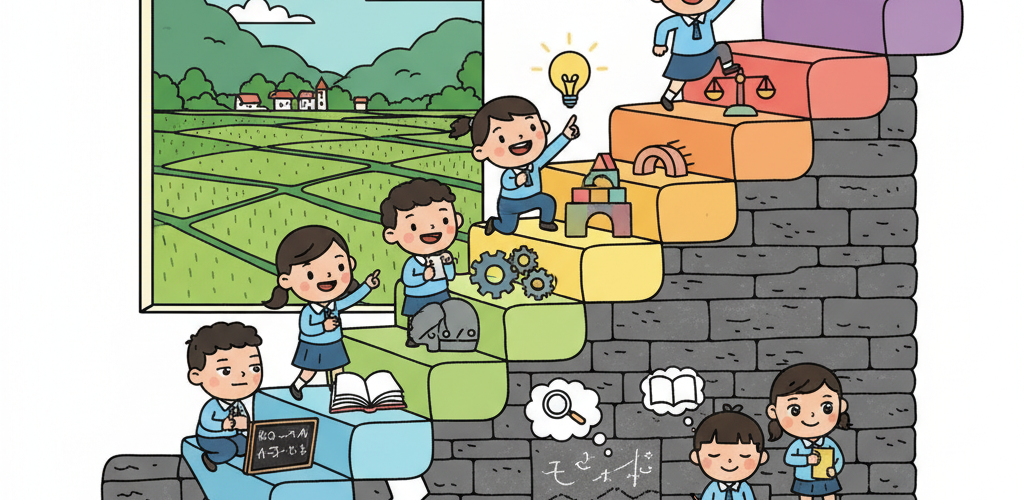
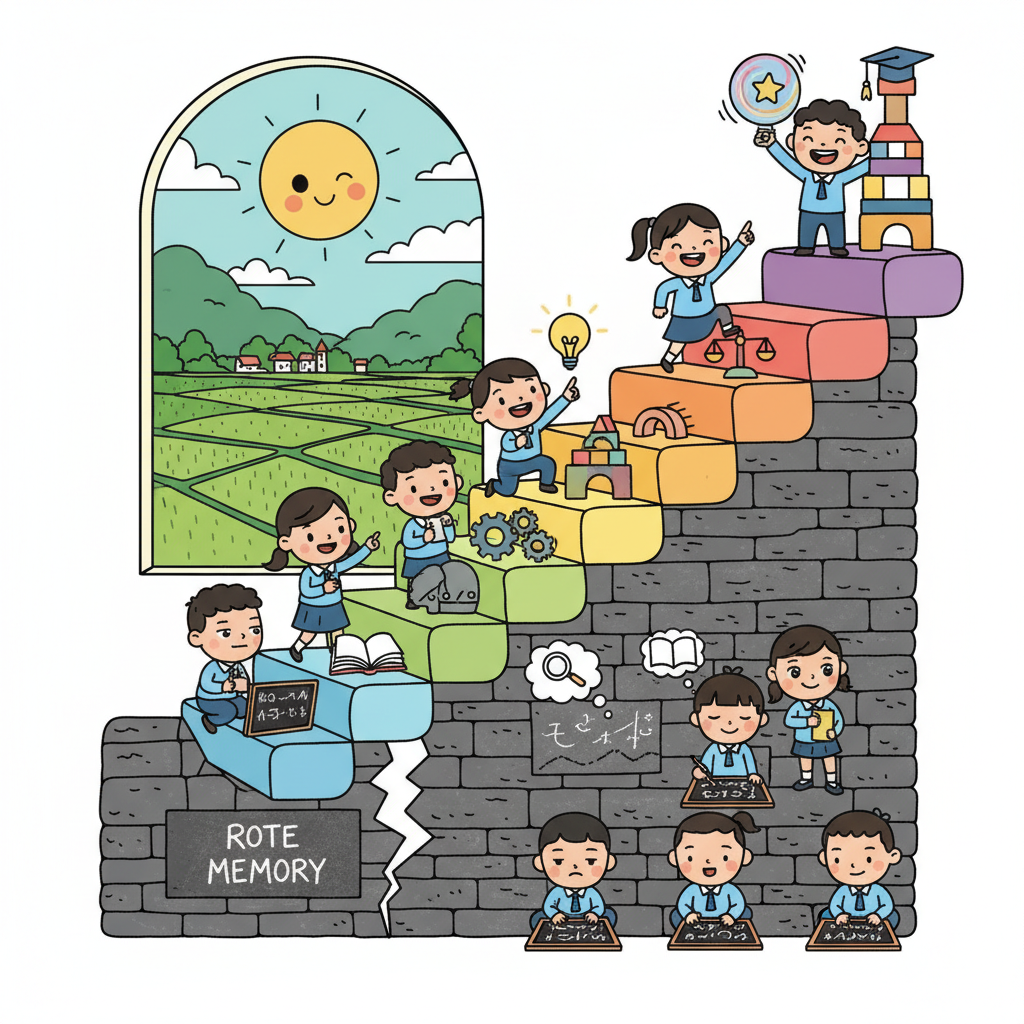
Developed in 1956 and later revised, Bloom’s Taxonomy categorizes cognitive learning into six hierarchical stages: remembering, understanding, applying, analyzing, evaluating, and creating. These stages are widely recognized internationally as essential for fostering higher-order cognitive skills (HOCS) and facilitating deeper, more durable learning outcomes. Empirical evidence from global education research consistently indicates that students exposed to structured cognitive progression demonstrate superior conceptual understanding, problem-solving capabilities, and creativity compared to peers confined to memorization-based instruction.
The Necessity of Bloom’s Taxonomy in Primary Education
Bangladesh’s primary classrooms are predominantly teacher-centric. Instruction typically involves a lecture-based delivery, followed by children’s recitation or completion of written exercises. This model restricts students’ opportunities to engage in self-directed inquiry or critical reflection. Cognitive development research, drawing on Piagetian and Vygotskian frameworks, underscores that children aged five to ten naturally learn through exploration, questioning, and environmental observation. Suppressing these natural tendencies constrains curiosity, analytical thinking, and independent learning.
Bloom’s Taxonomy provides a structured methodology to restore and amplify children’s inherent curiosity. By emphasizing progression from knowledge acquisition to comprehension, application, analysis, evaluation, and finally creation, it encourages learners to transition from passive recipients of information to active constructors of knowledge. For example, a child memorizing the characteristics of birds (remembering) may progress to explaining migratory patterns (understanding), applying this knowledge in a local observation project (applying), analyzing environmental influences (analyzing), evaluating conservation measures (evaluating), and ultimately designing a small awareness campaign (creating). Such structured learning not only strengthens cognition but fosters confidence and motivation.
Policy Reforms and the Implementation Gap
The 2012 and 2018 curriculum reforms in Bangladesh explicitly emphasize competency-based learning, project-oriented assignments, and analytical questioning. These reforms align with Bloom’s conceptual model. However, field-level assessments reveal persistent gaps between policy intent and classroom practice. Overcrowded classrooms, inadequate learning resources, limited teacher training, and entrenched examination culture are major obstacles.
While many educators are theoretically familiar with Bloom’s Taxonomy, translating it into daily pedagogical practice remains limited. Studies from DPE and the Education Watch program indicate that hands-on learning such as manipulatives in mathematics, story analysis in language classes, and student-led observations in science rarely occur in practice, largely due to lack of support, materials, or confidence among teachers.
Global Evidence and Lessons for Bangladesh
International research highlights that primary education systems that encourage analysis, application, and creativity produce students with enhanced cognitive skills. For instance, Finland’s curriculum emphasizes active learning and student-led inquiry; South Korea incorporates project-based learning and peer collaboration; Japan blends observation, reflection, and practical application from early grades. In contrast, Bangladeshi students, despite being inherently curious, are often confined to rote repetition for five or more consecutive years, limiting the development of higher-order thinking.
The literature also demonstrates that learners who regularly engage with tasks involving creation, evaluation, and problem-solving develop stronger self-efficacy and adaptability. For Bangladesh, this implies that integrating Bloom’s higher-order stages into primary curricula could enhance both immediate learning outcomes and long-term cognitive resilience.
Teacher Professional Development and Pedagogical Shifts
A key determinant of successful taxonomy-based instruction is teacher capacity. In the Bangladeshi context, many teachers are committed but constrained by limited pedagogical strategies. Transitioning to a Bloom-centered classroom requires teachers to become facilitators rather than mere transmitters of information. They must guide inquiry, scaffold independent exploration, encourage collaborative problem-solving, and support critical reflection.
Empirical studies from UNESCO and regional teacher training programs indicate that structured professional development significantly improves teacher efficacy and student learning outcomes. For instance, teachers receiving regular, practical training in cognitive scaffolding demonstrate higher confidence in classroom management and facilitate richer student engagement. Therefore, systematic, school-based, and continuous professional development is essential, complemented by lesson planning support, digital training modules, and cluster-level mentoring networks.
Parental Attitudes and the Socio-Cultural Context
Parental perceptions strongly influence classroom practice. In Bangladesh, a large proportion of parents prioritize exam scores over comprehension or skill development. Research shows that children in exam-centric households often associate learning with obligation rather than curiosity, limiting intrinsic motivation. Schools must therefore actively engage parents, communicating the value of conceptual understanding, applied knowledge, and creativity. Parental awareness campaigns, workshops, and transparent reporting of students’ progress beyond grades can foster supportive home environments conducive to Bloom-informed pedagogy.
Assessment Reform: Moving Beyond Memorization
Assessment practices in Bangladesh remain heavily summative and numerically driven. Evaluating higher-order cognitive skills requires multi-dimensional strategies, including project-based assessments, oral presentations, group problem-solving, observation-based evaluation, and real-world application tasks. Continuous assessment frameworks reduce stress and foster learning as a process rather than a finite goal, consistent with international best practices.
Research indicates that formative and performance-based assessments not only capture deeper learning but also reinforce classroom engagement, self-directed inquiry, and creativity, all critical outcomes of taxonomy-driven pedagogy.
Conclusion
Bangladesh’s primary education system stands at a critical juncture. Decades of rote-based instruction have constrained students’ capacity for analytical thinking, creativity, and inquiry. Bloom’s Taxonomy offers a structured, evidence-based framework to address these limitations, guiding learners from knowledge acquisition to creation.
Successful integration, however, depends on coordinated efforts across multiple levels: policy formulation, teacher training, classroom practice, parental engagement, and assessment reform. Evidence from international studies underscores that countries investing in these dimensions achieve sustainable improvements in cognitive development and learner autonomy.
For Bangladesh, the imperative is clear: if the next generation is to emerge confident, adaptive, and innovative, Bloom’s Taxonomy must not remain theoretical; it must shape classroom practice, assessment, and the culture of learning itself. Only then will primary education move from rote memorization toward a pedagogy that truly cultivates curiosity, reasoning, and creativity, securing both immediate learning gains and long-term cognitive resilience.