Review & Policy Synthesis:Reorienting Global Citizenship Education in Early Childhood Education From Instrumental Compassion to Critical Justice in BD
I. Introduction: The Critical Imperative of Global Citizenship Education in Bangladesh
The rapid acceleration of globalization has fundamentally reshaped social, economic, and political dynamics worldwide, intensifying existing global challenges such as inequality, cultural fragmentation, and environmental degradation.1 In response, educational systems globally require substantial transformation not minor adjustments to equip students with the necessary competencies to navigate 21st-century realities.2 Global Citizenship Education (GCE) has emerged as a transformative educational framework designed to cultivate global responsibility, empathy, and active engagement with these complex issues.1
A. Global Context and Local Urgency
For Bangladesh, a rapidly developing nation in the Global South, integrating GCE into its foundational education is not merely aspirational but imperative. The nation’s commitment to educational reform is encapsulated in the National Curriculum Framework (NCF) 2021, which aims to make classrooms more student-centered and incorporate experiential learning.2 This framework mandates the inclusion of “Social and Global Citizenship” as a core competency.3
However, the effective implementation of GCE hinges critically on its integration during the Early Childhood Education (ECE) phase. ECE is universally recognized as a crucial developmental period, influencing cognitive, verbal, and social development well into primary school and beyond.4 The World Bank also highlights the long-term benefits derived from supporting early childhood development, ranging from improved growth and development to enhanced productivity later in life.
B. Problem Statement: Gaps in Research and Policy
The proposed title, “Global Citizenship in Early Childhood Education: Building the Roots of a Compassionate Bangladesh,” while evocative, risks aligning with a simplistic, instrumental interpretation of GCE. For a rigorous academic contribution, the intellectual focus must be elevated to address the theoretical, empirical, and political complexities inherent in integrating such a framework in a South Asian context.
First, there is a global research scarcity: a comprehensive review of GCE literature found that studies overwhelmingly focus on higher education (46%) and secondary school (33%), with a mere 3% dedicated to ECE.6 This scarcity underscores the urgent need for context-specific research to bridge the gap between abstract GCE theory and classroom practice during these crucial formative years.6
Second, the structural challenge in Bangladesh lies in the disconnect between high policy ambition and implementation priority. While the NCF 2021 mandates comprehensive socio-emotional competencies like solidarity and global citizenship 3, adopting this mandate without a deeply critical and contextualized theoretical framework risks reinforcing neoliberal principles or sustaining existing global inequalities, as critics have argued regarding generic GCE frameworks.1
C. Thesis and Structure of the Review
The central argument of this expert critique is that successful implementation of GCE in Bangladesh’s ECE requires a radical theoretical pivot from an instrumental or superficial framing to a Critical Global Citizenship Education (CGCE) approach. This pivot must directly address the deep structural, pedagogical, and policy implementation deficits revealed by the NCF 2021 roll-out.
This report proceeds by: 1) rigorously defining the theoretical necessity for a critical, de colonial GCE framework; 2) analyzing the structural conflicts and policy prioritization gaps within the NCF 2021; 3) detailing the empirical pedagogical deficits, particularly the prevalence of rote learning; and 4) proposing actionable, evidence-based recommendations for transformative change in pedagogy, teacher capacity, and assessment.
II. Theoretical Foundations: Reframing GCE from Compassion to Critical Justice
The concept of GCE is highly contested and diffuse, risking a loss of meaning if not anchored in specific theoretical objectives related to globalization, citizenship, and education itself.6 A nuanced analysis of the literature reveals two primary theoretical trends that must inform any successful academic treatment of GCE in policy: the Instrumental Trend and the Critical Trend.6
A. Typologies of Global Citizenship Education
The Instrumental Trend of GCE is largely influenced by neoliberal visions and is primarily geared toward ensuring learners acquire the necessary competencies to be successfully developed in the globalized world.6 This perspective often focuses on basic interconnectedness and economic collaboration. Conversely, the Critical Trend adopts a more radical and transformational perspective, emphasizing social justice, awareness of being part of a global community, and an ethic dedicated to change and the common good.6 Scholars have noted that a GCE that fails to integrate ethical and justice-oriented perspectives can inadvertently reinforce neoliberal principles and perpetuate existing global inequalities.1
The UNESCO (2018) framework, often used as a general guide, addresses GCE through three core conceptual domains: Knowledge (cognitive), Heart (socio-emotional), and Action (behavioral).6 While useful for pedagogical structure, this definition, originating from an institution within the global governance framework, tends to emphasize learning psychology and, to a lesser extent, the necessary political or post-colonialist discourses.6 A robust framework for Bangladesh must therefore explicitly adopt a Critical Global Citizenship Education (CGCE) lens, which views citizenship not as a passive state but as a commitment to critically reflect on the world, challenge assumptions that create oppression, and pursue a more equitable and just society, echoing the principles of Freirean pedagogy.6
B. The De-colonial Imperative in South Asia
Implementing CGCE in Bangladesh necessitates addressing the nation’s historical context. De-colonial theory posits that educational systems in former colonies frequently perpetuate practices and knowledge systems inherited from the colonial past.7 Development narratives themselves, whether concerning health, agriculture, or education, are often driven by the Global North and bestowed upon the Global South, masking the agency of local populations.8
To achieve authentic, locally owned CGCE, the curriculum must move away from generic global values and root its principles in indigenous knowledge and national identity. The NCF 2021 provides a powerful mechanism for this pivot by mandating the upholding and nurturing of one’s own culture, history, heritage, and specifically, the spirit of the Liberation War.3 This emphasis connects GCE directly to political action and resistance against oppression a necessary move away from instrumental “compassion” towards transformative justice.
The original title’s focus on “Compassion” is problematic because it risks being interpreted as passive charity, a common pitfall of instrumental GCE. The NCF 2021, however, defines desired values such as Solidarity, which is described as the mindset of being united, working together to achieve a greater goal, and upholding humanistic values, despite differences and class divisions.3 This reframing of the goal from generic compassion to politically charged solidarity is essential for a de-colonial, justice-oriented GCE.
C. Defining CGCE Competencies for the ECE Learner in Bangladesh
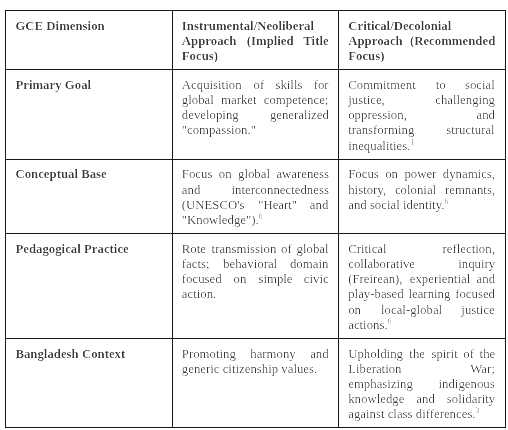
The required theoretical re-anchoring can be summarized by contrasting the instrumental and critical approaches across key dimensions, proving that the CGCE perspective is the only rigorous path for high-impact research and policy in this context.
Table 1: Reframing GCE for Policy Rigor: From Instrumental to Critical
III. The National Policy Landscape: Analyzing the NCF 2021 Policy-to-Practice Gap
The development of the National Curriculum Framework 2021 was based on expert research and designed to facilitate deep transformation in education.2 It successfully outlines a strong theoretical foundation for CGCE through its core competencies and defined values. However, a critical analysis of the implementation strategy reveals a structural flaw that risks neutralizing the GCE agenda at the ECE level.
A. NCF 2021: Ambition and Competency Mandate
The NCF 2021 aims for a competency-based curriculum that utilizes student-centered and experiential learning to foster development beyond traditional academic skills.2 The curriculum mandates several high-level competencies essential for CGCE. The “Social and Global Citizenship” core competency requires learners to respect difference and diversity by upholding their own culture and the spirit of the Liberation War, while also playing a role in building a safer world.3 Furthermore, the “Religion, Values and Ethics” learning area specifically targets the acquisition of complex values such as honesty, fairness, cooperation, empathy, respect for diversity, integrity, sense of humanity, and love for nature.3
These defined values and competencies, particularly solidarity defined as working together despite differences provide a strong local and philosophical base for implementing a critical, transformative GCE.3
B. Critiquing Policy Prioritization in ECE
Despite the strong mandate for values and citizenship, the NCF 2021 structure contains an inherent contradiction regarding resource and time allocation. The document explicitly states that relative emphasis has been given to different learning areas at different levels. Crucially, at the pre-primary and primary levels, foundational skills namely, mother language, communication, and mathematical skills have been given more emphasis.3
This subtle prioritization in policy document structure signals to implementers, teachers, trainers, parents, and assessors where the limited available resources and professional focus must be directed. The inevitable consequence is a zero-sum conflict between foundational skills and complex socio-emotional domains. Because literacy and numeracy are more easily measured and traditionally prioritized in high-stakes assessment systems, the ambitious, non-standardized socio-emotional and behavioral domains of GCE (Heart and Action) will be systematically overshadowed and de-prioritized.6 This structural choice ensures that the high-level CGCE goals remain theoretical rather than practical in the daily classroom experience of young learners.
C. The Governance Gap Hindering Policy Execution
The theoretical conflicts are exacerbated by systemic governance challenges common to large-scale policy implementation in Bangladesh. The transition from policy design to successful execution is frequently hindered by factors such as bureaucratic inefficiency, corruption, political instability, lack of coordination, and insufficient resource allocation.10
For a complex, resource-intensive initiative like integrating CGCE, which demands massive teacher retraining and the timely distribution of updated materials 11, these systemic issues present a third-order structural barrier. The persistent disconnect between policy formulation and its practical implementation suggests that even perfectly designed CGCE curricula will likely fail to achieve desired outcomes if the underlying administrative and financial structures are not addressed.10 Resource allocation, which includes adequate funding, provision of sufficient textbooks, and necessary infrastructure, is cited as a major hurdle to the effective roll out of the NCF.11
IV. Empirical Reality: Pedagogical and Capacity Deficits in ECE
The successful execution of CGCE depends on a radical transformation of pedagogical practices, yet empirical evidence confirms that the existing ECE system in Bangladesh is constrained by pervasive traditional methodologies and significant quality deficits.
A. The Quality Deficit and Ambiguous Definition
Research confirms a positive correlation between quality ECE and enhanced child learning outcomes in Bangladesh. However, the precise criteria, definition, and interpretation of ‘quality’ for ECE remain varied and insufficiently studied and implemented.4 Compounding this issue, empirical reviews show significant variation in teachers’ qualifications and a lack of standardized materials and documented pedagogical practices in many ECE classrooms.4
B. Pedagogical Constraints: Rote Learning and the Lack of Play
The single greatest pedagogical barrier to realizing GCE goals is the prevalence of rote memorization. Before undergoing training, many ECE workers demonstrated no prior pedagogical knowledge and focused overwhelmingly on rote memorization, lacking proficiency in appropriate teaching methodologies for young learners.12 This continues despite the NCF 2021’s call for student-centered and experiential learning.2
The culture of rote learning is deeply intertwined with the absence of play-based learning.9 Play-based pedagogy is fundamental for developing the socio-emotional competencies (empathy, cooperation, critical thinking) that underpin CGCE. Yet, the research indicates that the lack of play in Bangladesh ECE is often attributed to a combination of weak government policy initiatives and pressure derived from parental socioeconomic situations.9 Parents frequently prioritize academic books over toys, rushing children through rigorous academic schedules.9
This situation represents a critical failure to implement the “Heart” and “Action” domains of GCE.6 CGCE demands that individuals be able to critically reflect on the world and challenge assumptions that create oppression.6 If children are deprived of the opportunity for collaborative inquiry and experiential learning from an early age through play, they will lack the necessary tools for critical interpretation of social facts, making it impossible for them to formulate arguments or make decisions relating to social justice actions.6 The pervasive reliance on rote methods, focused solely on cognitive transmission, actively undermines the foundational development required for critical citizenship.
C. The Human Resource Crisis: Teacher Capacity and Training Quality
The capacity of teachers is the ultimate determinant of CGCE success. While government statistics indicate a seemingly high rate of trained teachers in primary education (77.26% in 2023) 13, this numerical sufficiency obscures deep qualitative deficiencies.
The success of the NCF relies heavily on teachers being well-prepared to deliver the new curriculum, yet the quality of participant teachers and trainers in the massive government training programs has been questioned by various stakeholders.11 CGCE requires specialized training to facilitate critical discussion and embed non-traditional content.15 If teachers lack this specialized preparation or fail to implement learned knowledge inside the classroom 12, the pedagogical inertia will maintain the status quo of rote transmission.
Furthermore, physical capacity constraints hinder the implementation of experiential CGCE methods. The student-teacher ratio (STR) in Bangladesh is high, recorded at 1:34 in 2023 14, exceeding the expected general ratio of 1:29.16 High STRs impede the individualized attention and collaborative, student-centered activities crucial for developing critical socio-emotional skills.2
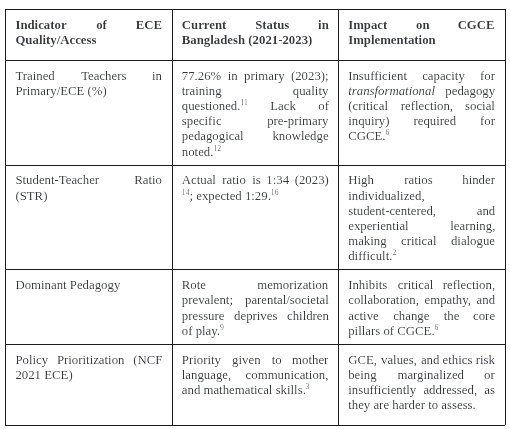
The relationship between the current status of ECE teacher capacity and the demands of CGCE is detailed below.
Table 2: Key Policy and Implementation Gaps in Bangladesh ECE
V. Policy-to-Practice Recommendations for Transformative Change
To successfully move GCE in Bangladesh’s ECE from an abstract policy concept toward a genuinely transformative practice, structural deficits must be addressed through targeted policy and pedagogical reforms rooted in a critical and de-colonial framework.
A. Integrating CGCE into ECE Teacher Training (The Epistemic Shift)
Teacher education must undergo a fundamental shift, moving beyond simple compliance training to foster an “epistemic shift” among educators.17
- Mandate Critical Pedagogy: Specific GCE content and critical pedagogical approaches must be embedded into pre-service and in-service programs to increase teachers’ sense of self-preparedness and confidence in delivering GCE opportunities.15 This training must emphasize how to integrate Freirean concepts of critical reflection and collaborative inquiry into age-appropriate activities.6
- Decolonizing the Curriculum: Training should focus on de-colonial practices, instructing teachers on how to incorporate local and indigenous knowledge systems, community exploration, and accurate historical narratives, such as the multiple perspectives surrounding colonial history and national narratives.8 This approach validates community practices and histories, moving away from curricula that solely reflect Global North perspectives.
B. Embracing Play-Based Learning as the Core GCE Methodology
Given the empirical finding that the lack of play undermines socio-emotional development necessary for CGCE 9, policy must explicitly mandate and resource play-based learning as the primary mechanism for ECE delivery.
- Policy Re-prioritization: Government policy formulation and stakeholder engagement must secure opportunities for establishing play-based learning in ECE.9 This requires mitigating the parental and societal pressures that favor academic books and rote work over play.9
- Model Scalability: Policymakers should analyze and scale successful, culturally relevant, low-cost, high-impact models, such as the BRAC Play Labs.18 These models demonstrate that play-based learning which includes activities designed to develop children physically, socially, emotionally, and cognitively can be delivered effectively through community-driven centers, engaging parents in developing play materials.18 This approach proves that sophisticated CGCE methodology is achievable within the resource constraints of Bangladesh.
C. Reform of Assessment and Curriculum Materials
The existing assessment system, often reliant on traditional exams, is inadequate for gauging the complex skills and competencies instilled by the NCF and CGCE.11
- Competency-Based Assessment: New assessment methods must be developed that rigorously align with the socio-emotional and behavioral outcomes of CGCE. Evaluation must measure skills such as empathy, fairness, and the capacity for critical reflection and problem analysis, rather than focusing purely on rote knowledge retention.6
- Localized Curriculum Development: To satisfy the de-colonial imperative, curriculum development must be decentralized. Materials should incorporate locally relevant and indigenous knowledge systems.7 Ensuring that updated, culturally relevant textbooks and supplementary materials are produced and distributed in a timely manner is a persistent challenge that requires careful planning and coordination.11
D. Financing and Accountability for Quality ECE
Sustained funding and financial accountability are necessary to overcome resource allocation challenges.11
- Strategic Financing: Bangladesh should leverage the support structures provided by global partners, such as the World Bank, which offer financing, policy advice, and technical support for quality ECE.5 Collaboration within frameworks like the Education Finance Watch (EFW), a partnership between the World Bank, the Global Education Monitoring (GEM) Report, and the UNESCO Institute for Statistics (UIS), can ensure objective analysis of education financing trends and issues, leading to more strategic investment in the quality of ECE.20
- Governance Improvement: Solutions must be formulated to address systemic policy execution deficits, including improving bureaucratic efficiency and coordination, to ensure resources allocated for teacher training and quality ECE materials reach the intended schools and benefit the children.10
VI. Conclusion: Building the Roots of Justice, Not Just Compassion
The aspiration to integrate Global Citizenship Education into Early Childhood Education in Bangladesh, as reflected in the NCF 2021, represents a monumental opportunity for educational transformation. However, to achieve its potential, the framework must be rigorously reoriented.
The core finding of this expert critique is that the proposed focus on “Compassionate Bangladesh” risks confining the initiative to an instrumental, neoliberal framework that fails to address the structural issues of inequality and power dynamics inherent in globalization.1 The true transformative potential lies in adopting a Critical Global Citizenship Education (CGCE) approach, which mandates engagement with social justice, de-colonial theory, and the specific historical and cultural identity of Bangladesh, including the spirit of the Liberation War.3
The pervasive pedagogical failures namely the domination of rote learning and the corresponding lack of play-based, experiential learning actively inhibit the development of the critical reflection skills and socio-emotional competencies required for GCE.6 This failure is structurally guaranteed by the NCF’s prioritization of easily measurable foundational skills (literacy/numeracy) over the complex, holistic requirements of citizenship education.3
Future research must urgently focus on empirical studies within non-university educational stages in Bangladesh to measure the impact of critical pedagogy and play-based learning on the socio-emotional development and CGCE competencies of young learners.6 Furthermore, policy analysis should investigate mechanisms required to shield ECE from high-stakes testing pressures that force a retreat into instrumental rote learning, thereby ensuring the NCF’s transformative vision is realized.
The development of the roots of a compassionate Bangladesh requires a deliberate, critical fostering of justice and solidarity, anchored in local context and achieved through specialized, quality training and a mandatory shift toward student-centered, play-based pedagogy. This systemic overhaul is necessary to transform policy ambition into profound, tangible social change.
Works cited
- Full article: Global citizenship education as a strategy for social, justice and identity: achieving balance for meaningful social impact – Taylor & Francis Online, accessed October 21, 2025, https://www.tandfonline.com/doi/full/10.1080/14767724.2025.2537371
- NCTB | PDF | Curriculum | Learning – Scribd, accessed October 21, 2025, https://www.scribd.com/document/650816477/nctb
- National Curriculum Framework 2021 – CHITTAGONG – portal.gov., accessed October 21, 2025, https://file-chittagong.portal.gov.bd/uploads/3501485c-b357-4cd0-8624-66e835222e4f/65b/8da/4cd/65b8da4cdd0d9185517429.pdf
- A Review of Early Childhood Education (ECE) in Bangladesh: Status and Impact, accessed October 21, 2025, https://www.researchgate.net/publication/338990625_A_Review_of_Early_Childhood_Education_ECE_in_Bangladesh_Status_and_Impact
- Early Childhood Development Overview – World Bank, accessed October 21, 2025, https://www.worldbank.org/en/topic/earlychildhooddevelopment
- Critical Global Citizenship Education: A Study on … – Frontiers, accessed October 21, 2025, https://www.frontiersin.org/journals/education/articles/10.3389/feduc.2022.867113/full
- A Comparative Study of the Curriculum Framework for Early Childhood Education in South Africa and Kenya, accessed October 21, 2025, https://www.su.se/polopoly_fs/1.571093.1631107009!/menu/standard/file/Ananmalay_Verushka-%20Final.pdf
- DEVELOPMENT – Aspen Institute, accessed October 21, 2025, https://www.aspeninstitute.org/wp-content/uploads/2025/05/Decolonising-Development-South-Asia.pdf
- Influence of Play-based Learning in Early Childhood Education (ECE) in Bangladesh: Lessons from Japan* – ResearchGate, accessed October 21, 2025, https://www.researchgate.net/profile/Dr-Alam-17/publication/360401029_Influence_of_Play-based_Learning_in_Early_Childhood_Education_ECE_in_Bangladesh_Lessons_from_Japan/links/6278fc1fb1ad9f66c8add430/Influence-of-Play-based-Learning-in-Early-Childhood-Education-ECE-in-Bangladesh-Lessons-from-Japan.pdf
- The Policy-Practice Gap in Bangladesh: Unpacking Barriers and Results, accessed October 21, 2025, https://slamultitechpublisher.my.id/index.php/ijgsr/article/download/34/36
- Bangladesh National Curriculum framework 2021: Challenges and possibilities – শিক্ষক বাতায়ন, accessed October 21, 2025, https://www.teachers.gov.bd/blog/details/758814?page=554&bangladesh-national-
- Exploring the Landscape of Early Childhood Teacher Training in Bangladesh – Murdoch Research Portal, accessed October 21, 2025, https://researchportal.murdoch.edu.au/esploro/fulltext/journalArticle/Exploring-the-Landscape-of-Early-Childhood/991005788079607891?repId=12179818170007891&mId=13179818160007891&institution=61MUN_INST
- Bangladesh Trained teachers in primary education – data, chart | TheGlobalEconomy.com, accessed October 21, 2025, https://www.theglobaleconomy.com/Bangladesh/Trained_teachers_primary_education/
- Bangladesh Education Statistics 2023, accessed October 21, 2025, https://banbeis.portal.gov.bd/sites/default/files/files/banbeis.portal.gov.bd/npfblock/Bangladesh%20Education%20Statistics%202023%20%281%29.pdf
- Global Citizenship Education in Early Childhood Education – DORAS | DCU Research Repository, accessed October 21, 2025, https://doras.dcu.ie/30759/1/OnlineFINALGCEinECE.pdf
- Annual Primary School Census (APSC) 2023, accessed October 21, 2025, https://www.dpe.gov.bd/sites/default/files/files/dpe.portal.gov.bd/publications/bfe86b94_5ace_4216_8d21_05b99550b57f/Final%20Report%20APSC%202023.pdf
- Innovations in Higher Education. Decolonization Is Not a Buzz Word: (Re)Envisioning Early Childhood Teacher Education Through Curriculum Design | NAEYC, accessed October 21, 2025, https://www.naeyc.org/resources/pubs/yc/summer2024/decolonization-in-ece
- Early Childhood Development – BRAC International, accessed October 21, 2025, https://bracinternational.org/early-childhood-development-2/
- An Evaluation of BRAC Pre-primary Education Programme, accessed October 21, 2025, https://bigd.bracu.ac.bd/publications/an-evaluation-of-brac-pre-primary-education-program/
- Publication: Education Finance Watch 2024 – World Bank Open Knowledge Repository, accessed October 21, 2025, https://openknowledge.worldbank.org/entities/publication/b998bf8a-19c6-4f35-aca6-e63229d64cad