Learning Language Through Play: Why Primary Education Needs a New Way of Thinking
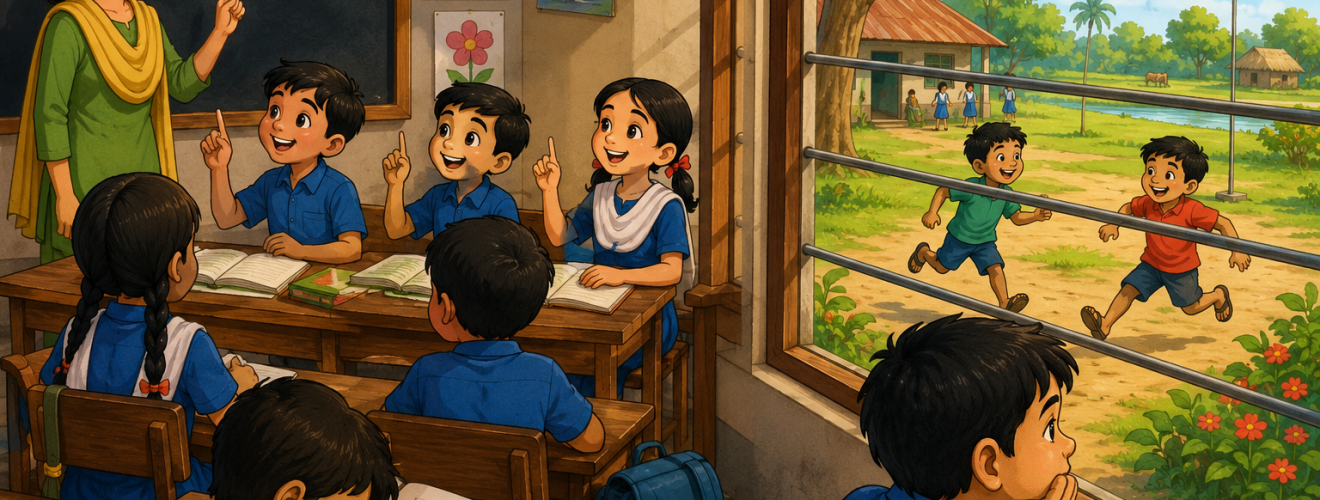
In a rural primary school classroom, an English lesson is taking place. On the blackboard, the teacher has written three familiar words: “farmer,” “doctor,” and “teacher.” A few students in the front row repeat the pronunciations carefully after the teacher. At the back of the room, however, another child quietly sketches in the corner of a notebook, while someone else stares through the classroom window toward the playground where children are running freely and laughing without restraint. Inside the classroom, language is being taught. Outside the classroom, language is being lived. Perhaps one of the greatest contradictions of primary education exists within this very scene.
In our effort to teach children language, we often remove the naturalness that gives language its meaning. The classroom becomes dominated by grammar rules, memorization, textbook exercises, and correction. Children are taught sentence structures before they are encouraged to speak. They are asked to avoid mistakes before they are given confidence to express themselves. Somewhere within this process, language slowly turns into an academic burden rather than a living human experience. Yet children do not learn language mechanically. A child does not begin speaking by memorizing grammar charts or analyzing tenses. Language develops through listening, observing, imitating, experimenting, and interacting with people. Children often begin using words before fully understanding them. They make mistakes, repeat sounds incorrectly, invent expressions, and gradually learn through communication itself. If we observe how children acquire their first language, the process becomes remarkably clear. There is no formal syllabus in early childhood, no examinations, and no structured lesson plans. Yet language develops naturally because it is connected to emotion, curiosity, relationships, and necessity.
Ironically, once children enter school, we frequently make language feel unnatural and intimidating, especially English. Many children who speak confidently at home suddenly become silent in English classrooms. They begin fearing grammatical mistakes, incorrect pronunciation, or the laughter of classmates. Sometimes they fear the teacher’s irritation even more than the lesson itself. Before children truly begin learning the language, they often begin emotionally distancing themselves from it. Later, adults become frustrated and ask why students study English for years yet still struggle to speak fluently or express themselves confidently. But perhaps the problem is not simply the child’s ability. Perhaps the problem also lies within the environment we create for learning.
In many schools, a “good classroom” is still imagined as a quiet classroom where children sit silently while the teacher speaks continuously. Discipline becomes associated with stillness. Yet childhood itself is not naturally silent. Young children learn through movement, imagination, curiosity, and interaction. If a six-year-old child is forced to remain physically and emotionally restrained for long periods, learning gradually becomes exhausting rather than meaningful. Some children eventually disconnect themselves from the classroom altogether—not because they lack intelligence, but because the classroom no longer feels connected to how they naturally experience the world. Learning in early childhood is never purely intellectual. Children learn through emotion, movement, play, relationships, and sensory experience. This is precisely why play-based learning matters so deeply in primary education.
Consider a simple English lesson about animals. A teacher may choose the familiar method: writing vocabulary on the board, asking students to repeat words, and assigning memorization for homework. Some children may memorize the lesson temporarily, but meaningful learning often remains limited. Now imagine a different classroom. One child imitates an elephant while another pretends to be a cat. The rest of the class guesses the animal in English. Someone says the wrong word, and instead of embarrassment, the mistake becomes part of the game. The classroom grows noisy, energetic, and imperfect. Yet children become emotionally engaged. They begin participating without fear. From the outside, such a classroom may appear less disciplined. But children’s learning cannot always be measured through silence. Sometimes genuine learning sounds like excitement, laughter, movement, and conversation. Unfortunately, in many educational cultures, play is still viewed as something secondary. There is often pressure to make children “serious” as quickly as possible, as though meaningful learning must always appear formal and rigid. Yet children naturally learn some of life’s most complex skills through play. They develop communication abilities, social understanding, emotional awareness, creativity, and problem-solving through playful interaction. When a child pretends to be a shopkeeper and says, “Here is your money,” that child is not merely playing. The child is learning language within a real social context.
Storytelling carries similar importance. Yet stories are gradually disappearing from many classrooms because stories are not directly measurable in examinations. But language is not merely an academic subject; it is deeply connected to emotion and imagination. When a teacher pauses during a story and children eagerly ask, “Then what happened? ”, something powerful occurs. Curiosity becomes active. Attention becomes natural. Language begins carrying emotional meaning. And emotional connection matters deeply in education. A language disconnected from emotion often remains memorized information rather than becoming part of a child’s authentic voice. Children may pass examinations, yet still hesitate to communicate freely because the language never truly became their own. Of course, the realities of education systems cannot be ignored. Teachers face overcrowded classrooms, administrative pressure, limited resources, and the constant pressure of completing the syllabus. Meaningful transformation is not always easy. But not every change requires large-scale reform. Sometimes small shifts in classroom culture can create meaningful impact.
Perhaps a teacher allows children five extra minutes to speak freely in English without fear of correction. Perhaps mistakes are treated as part of learning rather than evidence of failure. Perhaps classrooms become spaces where children feel emotionally safe enough to try, fail, laugh, and try again. Because before children learn to speak correctly, they must first learn not to fear speaking at all. Primary education is an extraordinarily sensitive stage of human development. During these years, children are not only learning language; they are also developing beliefs about themselves. They begin forming ideas about whether their voice matters, whether they are capable, and whether learning feels welcoming or frightening. If language education silences children emotionally, learning may still occur superficially, but genuine development remains incomplete.
Perhaps our classrooms need to become a little more alive, a little more expressive, and a little more human. Perhaps children should not only be taught correct grammar and perfect sentences. Perhaps they should also be taught confidence, curiosity, and the courage to speak without fear. Because language is not simply something children study. It is something they live.