Three Forgotten Souls and a Nation’s Rebirth- “Beneath the Flag, They Stood
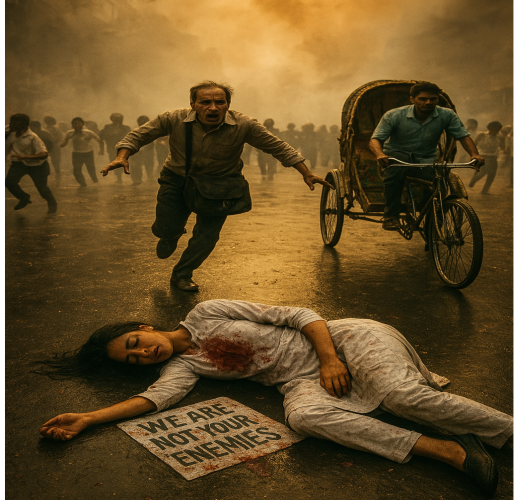
The August sun had risen like a fever over Dhaka, smearing the sky with a restless orange. From the balcony of her small rented flat in Shukrabad, Sabria Rahman watched the traffic pulse below the impatient horns, the vendors shouting “pani, cha, cha garam,” the smell of paratha and dust mixing in the air. Somewhere nearby, a group of students were already painting placards on the rooftop of a building. She could hear their brushes striking cardboard, their laughter too nervous to last long.
Sabria adjusted the strap of her worn canvas bag. Inside were her ID, a half-filled bottle of water, and the small folded flag of Bangladesh her father had given her when she started university. “One day you’ll wave it for something that matters,” he had said. She had laughed then, thinking of campus debates and youth festivals. She hadn’t imagined blood, tear gas, or gunfire.
Downstairs, a rickshaw bell rang. Sohag Mia, the puller who lived in a tin-roofed room behind the tea stall, was already on the road. His shirt was clean today, a light blue, faded but ironed. He hummed an old Bhawaiya tune from Kurigram, where the river had swallowed his land years ago. Each morning he prayed that no passenger would cheat him, no police would snatch his day’s earnings. But today, his prayer had been different: Allah, let me go where I am needed most.
The city felt charged, like a held breath. Posters were everywhere faces of martyrs, slogans demanding justice, pleas for peace. Rumors said the regime was planning to “teach the students a lesson.” Mr. Mahbub Rahman felt the weight of that phrase pressing on his chest. When he reached the main gate, he saw Sabria standing with a few classmates. Their eyes shone with both fear and defiance.
“Sir, you shouldn’t be here,” she said quietly.
“And you should?” he replied.
She smiled thin, but real. “Someone has to be, Sir!”
At the same hour, Mr. Mahbub sat at his desk in a quiet faculty room of the private university. He was marking essays about “The Ethics of Freedom.” Half of them quoted philosophers; only one student had written from the heart, Sabria. He had underlined her final line: “To be free is to care for the other, even when the cost is unbearable.”
He stared at that sentence for a long moment. Then he closed the paper, took his worn satchel, and stepped out into the heat.
They began walking together toward the intersection where the march would begin. Rickshaws moved like bright insects through the narrow lanes. On one of them, Sohag Mia was pedaling slowly, his passenger humming a patriotic song. When he saw the line of students forming ahead, he stopped. Something in their faces earnest, determined, trembling made him pull his rickshaw to the side of the road. He wiped his forehead and whispered, “Allah, keep them safe.”
Sabria felt the first gust of tear gas long before she saw the police. The crowd tensed; slogans faltered into coughs. Someone shouted for masks, for water. Mahbub’s instinct was to gather his students and turn back. But Sabria moved forward, lifting her placardhand-painted letters bleeding slightly from morning sweat:
“We are not your enemies.”
The police line advanced, shields glinting under the sun. Between the two crowds stretched an invisible border of fear. And yet, for one suspended second, silence hung in the air. A bird crossed the sky. Somewhere, a muezzin’s voice rose for Zuhr prayer.
Then came the crack of the first bullet.
Sabria felt the air shatter around her. She didn’t know she had been hit until the heat spread across her chest and her knees buckled. The placard fell.
“Sabria!” Mahbub shouted, running toward her as chaos erupted. Tear gas hissed, people screamed, sandals scattered on the asphalt.
Through the haze, a rickshaw bell sounded urgent, desperate. Sohag Mia appeared, weaving through the fleeing crowd. He jumped down, grabbed Sabria’s arm with calloused hands, and with Mahbub’s help lifted her into the rickshaw. Blood soaked through her white kurta.
“Hospital, fast!” Mahbub gasped.
Sohag nodded once. “jagaya rakhen bhai… onare chokh bujte diyen na.”
They moved through barricades and smoke, the rickshaw creaking like an old prayer. Behind them, the city roared a mix of sirens, slogans, and something deeper: the heartbeat of a people who refused to kneel.
The rickshaw wheels screamed against the road as Sohag Mia turned into the gate of the nearest hospital. His legs burned; the pedals felt like molten iron. He had never ridden this fast in his life. Behind him, Mr. Mahbub Rahman held Sabria in his arms, pressing a scarf against the wound on her chest. Blood had already soaked through. Her face was pale, her lips trembling with half-whispered words.
“Baba… baba ke bolben je ami bhoy pai nai…” she murmured.
Mahbub felt something tighten inside him, like a string about to snap.
“Shh… just breathe, Sabria. You’re safe now.”
The emergency ward doors burst open. For a moment, everyone froze at the sight of a girl, barely nineteen, blood spreading over her chest, the teacher shouting for help, the rickshaw puller drenched in sweat and tear gas. Nurses rushed forward. Someone called for a stretcher. Someone else began shouting at Sohag for bringing a “protest case.”
“Take her to surgery!” Mahbub yelled, voice cracking. “She’s a student, not a criminal!”
The nurse hesitated, eyes darting toward the security desk.
“Sir, the police are already on their way…”
“Then let them come,” Mahbub snapped. “Just save her life.”
Outside, the air was heavy with sirens and smoke. Protesters had scattered through alleys, some bleeding, some hiding in mosques or inside tea stalls. The news was spreading fast: a girl shot near Science Lab, unconscious, carried by a teacher and a rickshaw puller. Social media was already flooded with her photo, a shaky frame showing her placard half-bent on the road, the words We are not your enemies blurred by blood.
Inside the hospital, the world had shrunk to a hallway lined with peeling paint and the smell of disinfectant. Mahbub sat on a broken plastic chair outside the operation theatre. His shirt was still wet from Sabria’s blood. Sohag stood beside him, barefoot, his hands trembling slightly.
“You saved her life,” Mahbub said quietly.
Sohag shook his head. “Allah unare bachaise sir. ami to khali rickshaw da tansi.”
Mahbub looked at the man’s cracked feet, the veins like small rivers. He wanted to say something about dignity, about gratitude but the words felt small. Instead, he simply nodded.
Minutes became hours. Then came the sound of boots.
Two policemen entered the hallway, their uniforms still dusty from the street. One of them, younger and visibly shaken, looked around before pointing at Sohag.
“You! Rickshaw-wala! You took part in the protest?”
Sohag froze. “Na, sir, ami to khali… ”
“Shut up! You carried one of them. You’re under arrest.”
Mahbub rose instantly. “He’s innocent. I asked for his help. Arrest me if you must, but not him.”
The senior officer turned to him, frowning. “You’re the teacher, right? You’re all the same. You spoil them with big words freedom, rights, justice. And look where that got you.”
Mahbub met his eyes, steady. “It got her to the hospital alive.”
There was a silent chick, electric. Then, without a word, the police took both of them.
The cell was small, the air damp. A single bulb swung overhead. Mahbub sat on the floor, back against the wall, while Sohag crouched near the bars, still trying to process what had happened.
“Sir,” he said after a while, “why did they beat the boys? Why did they shoot the girl? She didn’t even throw a stone.”
Mahbub looked at him, eyes tired but still burning. “Because they’re afraid, Sohag. Power is always afraid of truth. That’s why civility is so dangerous to them.”
Sohag didn’t understand every word, but he felt the weight of them.
He thought of his daughter back in Kurigram same age as Sabria. He thought of how he’d always told her, “Don’t talk too loud, Maa. The world is not safe for brave girls.” And yet, here he was, locked up because a brave girl had needed saving.
That night, the jailer came with a paper. “The girl is alive,” he said bluntly. “But critical. Someone from the media took her photo to London. The government is denying they shot her.”
Mahbub closed his eyes in relief, whispering a prayer under his breath. Sohag smiled faintly. “Alhamdulillah.”
Two days later, a lawyer arrived and a thin man in a white panjabi arrived. He spoke to Mahbub quietly through the bars.
“Sir, the public pressure is growing. The footage is everywhere. You both might be released soon, but they’ll want silence.”
Mahbub frowned. “And if we don’t stay silent?”
The lawyer sighed. “Then they’ll make sure no one listens.”
Mahbub looked at Sohag, who was staring out at a strip of blue sky through the tiny window. “Maybe silence is what they fear most,” Mahbub said softly. “Because silence is the space where people start to think.”
That evening, a group of students and journalists gathered outside the station, demanding their release. They held candles, not slogans. Someone read Sabria’s line from her essay aloud:
“To be free is to care for the other, even when the cost is unbearable.”
The crowd repeated it like a prayer.
Inside the cell, Mahbub heard the murmur through the walls. He smiled for the first time since the march. Sohag looked at him, confused.
“What happened, sir?”
“They’re listening,” Mahbub said. “The street is learning to listen.”
At dawn, the lock clicked open. The officer didn’t look at them when he said, “You’re free to go.”
Outside, the city was still broken but alive. Smoke still clung to the trees, but the air felt different, like a wound learning to heal.
Sohag squinted at the light. “Sir, the girl… she’ll live?”
Mahbub nodded. “Yes. She will. And maybe we all will, if we remember what she stood for.”
They began walking, two silhouettes against the rising sun, the teacher and the rickshaw puller, side by side, carrying nothing but the simple courage that had bound them to a stranger’s life.
The monsoon returned in the first week of August, washing Dhaka in a relentless gray. Roads flooded, banners sagged, and the smell of wet earth mixed with the metallic taste of tension. Yet, beneath the rain and fear, something was shifting: whispers in tea stalls, quiet nods in classrooms, faces that had once looked down now daring to look up.
Inside a small ward of the government hospital, Sabria Rahman opened her eyes for the first time since that day. The ceiling fan spun lazily above her. Her chest burned when she tried to breathe, but the world was still there, rain tapping on the window, muffled voices outside.
Her first sight was Mr. Mahbub Rahman sitting beside her bed, soaked but smiling faintly. His beard had grown; his eyes carried the kind of tiredness that can’t be slept away.
“Sir…” she whispered, voice rough.
“Shh,” he said. “Don’t speak. You did enough speaking that day.”
Tears filled her eyes. “Did they arrest you?”
“They did,” he said simply. “But they couldn’t keep us forever. Too many eyes were watching.”
He looked at her, pride and sorrow mixing in his expression. “You stood in front of the guns, Sabria. I don’t know whether to scold you or salute you.”
She smiled faintly, pain twisting her lips. “You always told us the line between courage and foolishness is drawn by time.”
“And time,” he said, “has started drawing it for you.”
Across town, Sohag Mia was back on his rickshaw. The seat was torn, the wheels wobbled, but it still moved. People recognized him now as the puller who had saved the girl. Some offered free tea; others just stared, unsure how to treat a man who had done something extraordinary but looked so ordinary.
When journalists tried to interview him, he only said, “I did what any father would do.” Then he’d pedal away, his face disappearing into the crowd.
But that week, the streets were changing. Thousands of lives have already been lost; with their blood, a new chapter of history is being written.
The regime that had ruled through fear for decades was cracking under the weight of its own cruelty. Students refused to go home. Workers joined them. Mothers marched with photos of the fallen. The sound of the rain mixed with the rhythm of slogans not of rage, but of resolve.
Mahbub was invited to speak on a small radio show run by volunteers. He hesitated at first, then went. The host asked him what civility meant in times like these.
He thought for a long moment before replying, voice steady and human:
“Civility is not silence. It’s the courage to treat others as human even when they forget to treat you the same. It’s the choice to save a life when hatred says walk away.”
The line spread like fire. Students wrote it on walls, shared it on social media, made leaflets, and whispered it in buses. And in every repetition, the story of Sabria and Sohag traveled a little further.
August 5, 2024
No one saw it coming.
At noon, everyone was shouting out in joy and disbelief that the regime had fallen.
The military withdrew from the streets. The flags came down from government buildings, then went up again in the hands of citizens. All across the country, people poured into the rain. Strangers hugged. Buses stopped. Imams and priests prayed side by side. A city that had forgotten how to breathe finally exhaled. The entire nation seems to be immersed in an unspoken celebration, even though the bloodstains have not yet dried, nor has the grief of mothers who lost their children. People are shouting with joy, breathing freely for the first time, crying out with joy, “Apa has fled! Apa has fled!”
In the hospital corridor, Mahbub held Sabria’s hand as news burst through the loudspeakers. “They’re gone!” a nurse cried out, tears streaming down her face. “They fled! You did it, the students did it, Alhamdulillah! They killed my little brother… my little brother.”
For a moment, everything went still. The rain, the monitors, the breath between words all paused in awe. Then Sabria’s tears rolled silently across her cheek.
“We did it, sir,” she whispered.
“No,” he said softly. “Bangladesh did.”
He looked out the window. Crowds were already filling the streets, waving flags, chanting songs from the old days of freedom.
And amid all that joy, Mahbub felt a quiet ache.
He knew the country would move on. Names would fade, memories would blur. But history would remember what hearts forget.
That evening, Sohag Mia parked his rickshaw near Shahbagh and stood for a long time under the drizzle. People were singing Amar Sonar Bangla. Someone handed him a small flag; he held it without knowing what to do. He thought of his daughter in Kurigram, of the girl whose blood had stained his rickshaw, of the teacher who had refused to leave him behind.
He whispered, “Ei desh ta abar jitse, Allah, abar jitse.”
He looked up at the sky, the same sky that had watched everything and smiled.
Months later, the city began to heal. The banners came down, the roads were repaired, the slogans faded under new paint. But somewhere deep in the heart of Dhaka, people still remembered a morning in Red July when a girl stood before armed men and said, We are not your enemies.
They remembered a teacher who walked through smoke to save her.
And a rickshaw puller who became, without knowing it, the conscience of a nation.
Time would forget their faces. Newspapers would move on.
But in the unwritten memory of the people, their story would live whispered by mothers to daughters, retold by rickshaw pullers to passengers, recited by students in classrooms whenever freedom began to feel fragile again.
Because on that street, in that August, Bangladesh learned once more what it truly meant to be civil to be human, even when humanity was the hardest thing to be.
